Lecture 1: Electromagnetic Induction
Recommended Texts
- Hughes 2016, Electrical and Electronic Technology, Pearson.
- Hughes 2019, Electric Motors and Drives, 5th edition, Newnes.
- Richard Crowder, Electric Drives and Electromechanical Systems, Newnes.
- Austin Hughes, Electric Motors and Drives, Newnes.
- Syed A Nasar, Schaum’s Outlines — Electric Machines and Electromechanics, McGraw Hill.
- Ebook: Maxon Formulae Handbook
Course Structure
Class contact
- Lecture Monday 10–11
- Lecture Tuesday 4–5
- Tutorial Friday 11–12
Assessments
- 80% End of Semester Exam
- 20% Continuous Assessment
- 10% Assessment in conjunction with Intel
- 10% Mid-Semester Exam
Course topics
- Electromagnetism fundamentals
- DC motor basics
- Types of DC motors — permanent magnet, steppers, brushless DC, field generated etc.
- Servo systems
- Case study: drive selection
- DC–AC
- Phasors and complex notation
- Power in AC
- Transformers
- Single phase and three phase AC motors
- Speed control
- Motor selection
10 Things That Require No Talent
| Being on time | Energy |
| Work ethic | Interest |
| Effort | Being prepared |
| Body language | Being teachable |
| Attitude | Doing extra |
Introduction
A large section of this course can be summarised as describing how the interaction between electrical and magnetic fields can be exploited to perform mechanical tasks.
To that end, let’s spend some time looking at the basics of these interactions.
Electromagnetic Induction
Interactive diagram: drag the magnet into and out of the coil to see the induced current, the coil’s induced poles and a live plot of flux and emf · Open full screen ↗
A moving magnetic field passing through a loop of conducting wire induces a current.
Faraday’s law of Induction
\[ \varepsilon = -N\,\frac{\Delta \Phi}{\Delta t} \]
Where:
- \(\varepsilon\) = Electromotive force (Volts, V)
- \(N\) = Number of turns in the coil
- \(\Phi\) = Magnetic flux (Webers, Wb)
- \(t\) = time (s)
So where does the ‘\(-\)’ come into it?
Lenz’s Law
Lenz’s law states that the current induced in a circuit due to a change in a magnetic field is directed to oppose the change in flux and to exert a mechanical force which opposes the motion.
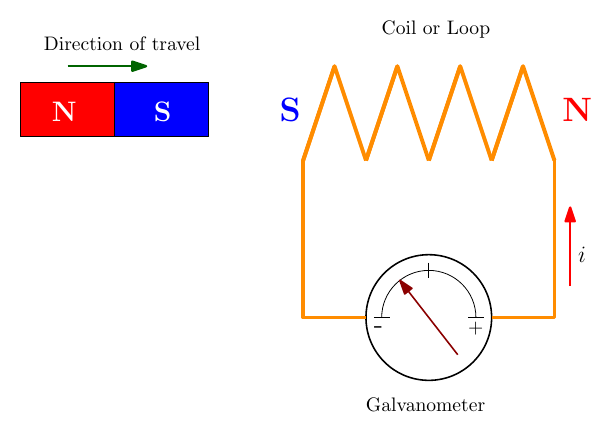
What this means is the current will flow such that the magnetic field generated by the current will oppose the moving magnetic field.
\[ \varepsilon = -N\,\frac{\Delta \Phi}{\Delta t} \]
Interactive diagram: pick case A–D, or choose the pole and the direction of motion, to see B₁, B₂, the induced current and the reasoning step by step; “Predict first” lets you test yourself · Open full screen ↗
In each of the four cases above, \(\vec{B}_1\) is the field of the moving magnet and \(\vec{B}_2\) is the field produced by the induced current \(i\) in the loop. The induced current always flows in the direction that makes \(\vec{B}_2\) oppose the change in flux through the loop.
Summary
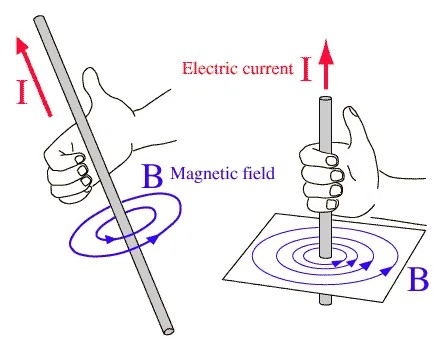
We have:
- A changing magnetic field induces a current.
- Current flow generates a magnetic field.
- Induced current opposes change in flux.
What happens if we apply a current to a conductor in a magnetic field?
Force on a current-carrying conductor
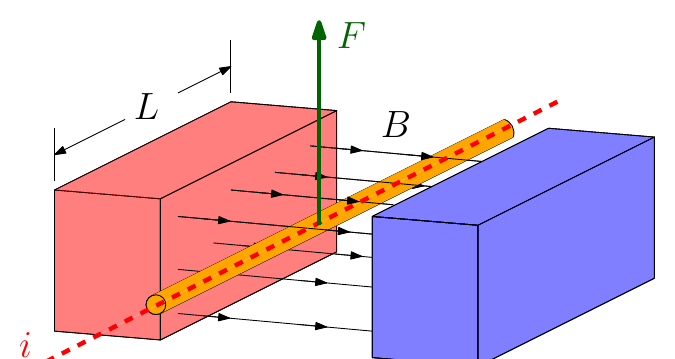
If we apply a current to the wire in a magnetic field then a force is exerted on the wire. The force is given by:
\[ \vec{F} = L\left(\vec{i} \times \vec{B}\right) \]
Where:
- \(\vec{F}\) = Force vector (Newtons, N)
- \(L\) = length of wire in the magnetic field (metres, m)
- \(\vec{i}\) = current (Amperes, A)
- \(\vec{B}\) = Magnetic field (Tesla, T)
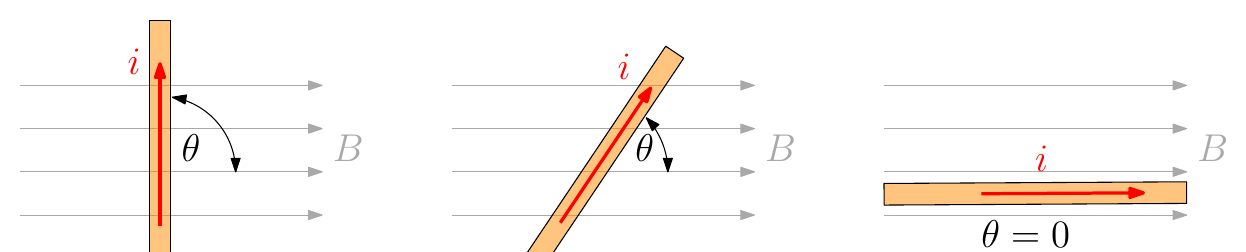
For this course we can typically consider the magnitude of the force to be:
\[ F = BiL\sin\theta \]
Where \(\theta\) is the angle between the magnetic field and current vectors. When the conductor is parallel to the field (\(\theta = 0\)) no force is produced; the force is greatest when the conductor is perpendicular to the field.
Interactive diagram: drag the wire round in the top view, or change \(B\), \(i\), \(L\) and \(\theta\) with the sliders, to see the force and where you are on the \(\sin\theta\) curve · Open full screen ↗
DC Motor Basics
Sample videos
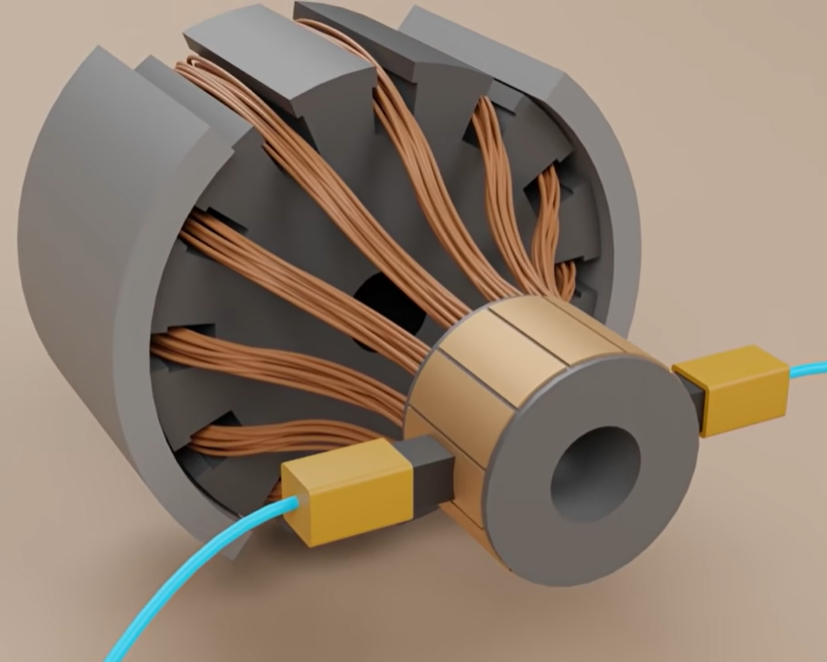 |
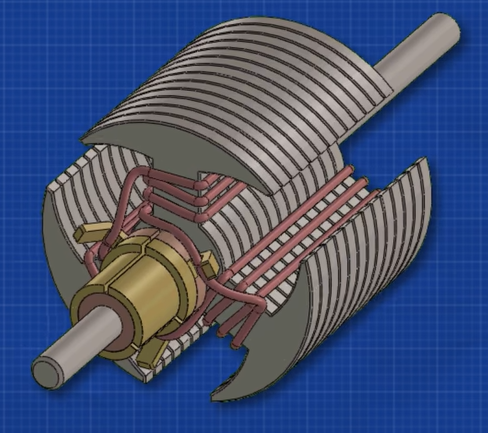 |
| Sample video 1 | Sample video 2 |
Permanent magnet DC motor
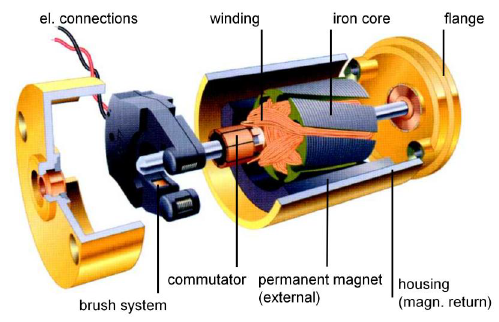
The DC motors described so far are known as permanent magnet DC motors and are among the simplest motor types there are. These motors are typically low power and are used in pumps, fans, robots, toys and electric cars.
Knowledge Check
Q1. State Faraday’s law of induction and explain each term.
Answer
\(\varepsilon = -N\,\dfrac{\Delta\Phi}{\Delta t}\): the induced e.m.f. \(\varepsilon\) (V) equals the number of turns \(N\) times the rate of change of magnetic flux \(\Phi\) (Wb) through the coil; the minus sign expresses Lenz’s law.
Q2. A magnet is held stationary inside a coil. Is an e.m.f. induced? Why?
Answer
No. An e.m.f. is induced only when the flux through the coil is changing. A stationary magnet gives a constant flux, so \(\Delta\Phi/\Delta t = 0\).
Q3. What does Lenz’s law state, and what does it say about the force on a magnet moving towards a coil?
Answer
The induced current flows in the direction that opposes the change in flux that produced it. The coil’s induced field therefore repels an approaching magnet (and attracts a retreating one): the force always opposes the motion.
Q4. The flux through a 200-turn coil changes from 2 mWb to 8 mWb in 0.1 s. What is the size of the induced e.m.f.?
Answer
\(|\varepsilon| = N\,\dfrac{\Delta\Phi}{\Delta t} = 200 \times \dfrac{(8 - 2)\times10^{-3}}{0.1} = 12\) V.
Q5. Why must the minus sign in Faraday’s law be there? What would happen without it?
Answer
Without it, the induced current would reinforce the change: the force would help the magnet move, increasing the change, inducing more current, and so on. The system would generate energy from nothing, violating conservation of energy.
Q6. A wire 0.2 m long carries 5 A at right angles to a field of 0.4 T. What is the force on it? What if it is at 30° to the field?
Answer
\(F = BiL\sin\theta = 0.4 \times 5 \times 0.2 \times \sin 90^\circ = 0.4\) N. At 30°: \(0.4 \times \sin 30^\circ = 0.2\) N.
Q7. When is the force on a current-carrying wire in a magnetic field zero?
Answer
When the current is parallel (or antiparallel) to the field, \(\theta = 0^\circ\) or \(180^\circ\), so \(\sin\theta = 0\) (or when \(B\), \(i\) or \(L\) is zero).
Q8. In which direction does the force \(\vec{F} = L(\vec{i} \times \vec{B})\) act?
Answer
At right angles to both the current and the magnetic field, as given by the cross product.
Q9. Name three typical applications of permanent magnet DC motors.
Answer
Any three of: pumps, fans, robots, toys, electric cars (generally low-power applications).