Feedtracks and Escapements
Chapter 17 · Part IV: Automated Assembly and Parts Feeding · Source: Lecture 16
17.1 Gravity feedtracks
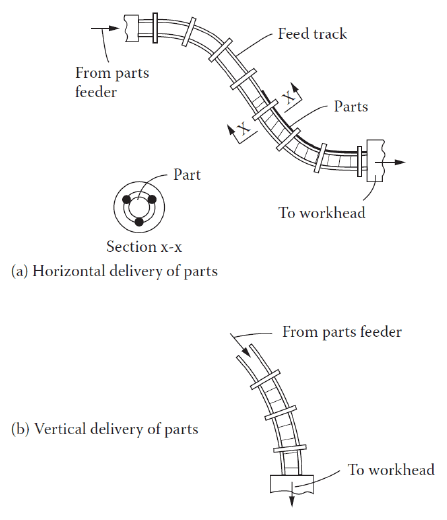
Figure 17.1: Gravity feedtracks delivering parts horizontally (a) and vertically (b).
The feed rate depends on the number of parts on the track, so the track should be kept fairly full. To achieve this, the orientation device is designed to over-feed, which can cause excessive wear on the bowl and damage to parts. The solution is high- and low-level sensors on the track that switch the feeder on and off.
Feedtracks are designed around the part geometry and should be accessible in case of jams. For headed parts, the track should be deep enough to avoid jamming when it is inclined towards the horizontal.
Horizontal feedtrack
A horizontal feedtrack relies on a preceding vertical (or inclined) section to push the parts along:
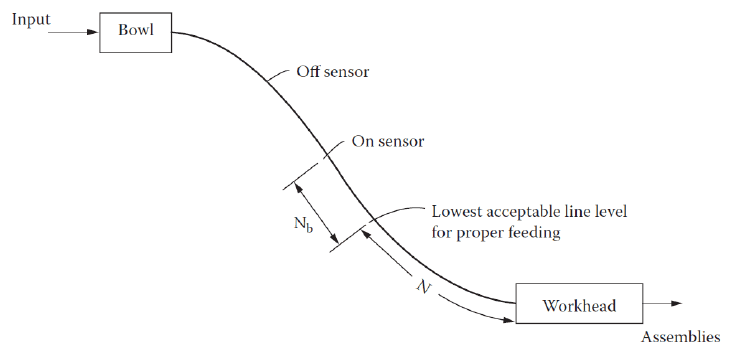
Figure 17.2: The bowl is switched by “off” and “on” level sensors; there is a lowest acceptable line level for proper feeding.
Vertical feedtrack
A vertical feedtrack has a constant feed rate, set by the time for a part to fall through its own length \(L\):
\[t = \sqrt{\frac{2L}{g}}\]
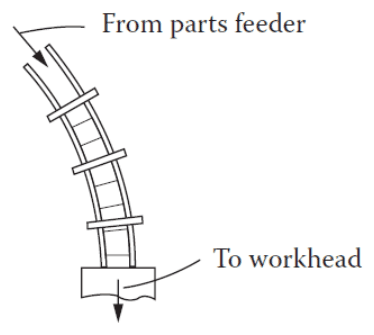
Figure 17.3: Vertical feedtrack.
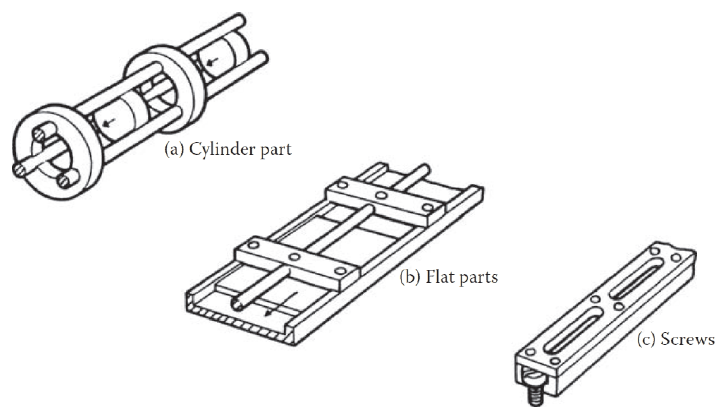
Figure 17.4: Feedtrack sections for (a) cylinders, (b) flat parts and (c) screws.
Friction effects
Take care when evaluating friction, because the track shape changes the normal forces.
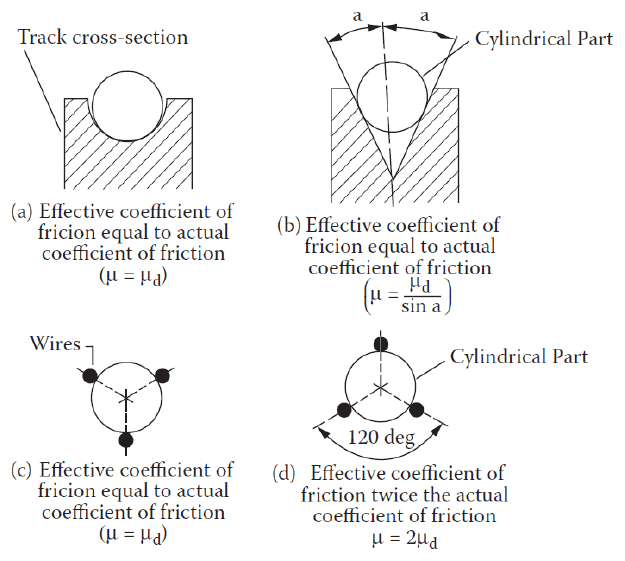
Figure 17.5: Effective friction for (a) a flat track, (b) a V-track, (c) wires and (d) wires at 120°.
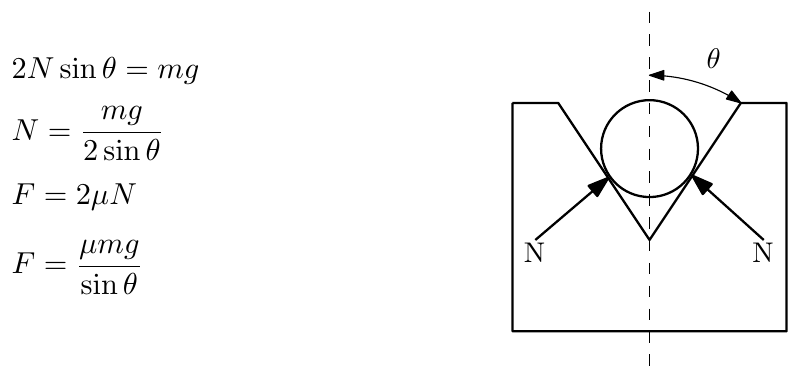
V-track (sides at angle \(\theta\) to the vertical):
\[2N\sin\theta = mg \;\Rightarrow\; N = \frac{mg}{2\sin\theta} \qquad F = 2\mu N = \frac{\mu mg}{\sin\theta}\]
Twin wires (120° apart):
\[2N\cos 60^\circ = mg \;\Rightarrow\; N = \frac{mg}{2\cos 60^\circ} \qquad F = 2\mu N = \frac{\mu mg}{\cos 60^\circ} = 2\mu mg\]
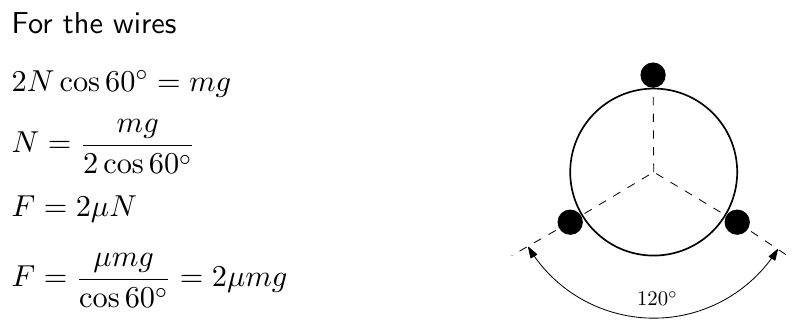
So a V-track or a wire track gives a higher effective coefficient of friction than a flat track: \(\mu_{eff} = \mu/\sin\theta\) for a V-track and \(2\mu\) for wires at 120°.
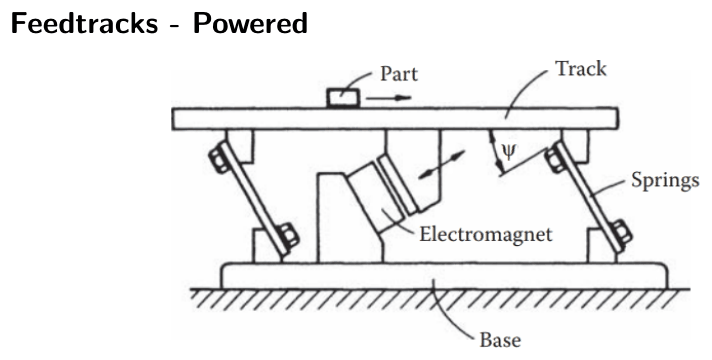
17.2 Powered feedtracks
| Vibratory | Air-assisted |
|---|---|
 |
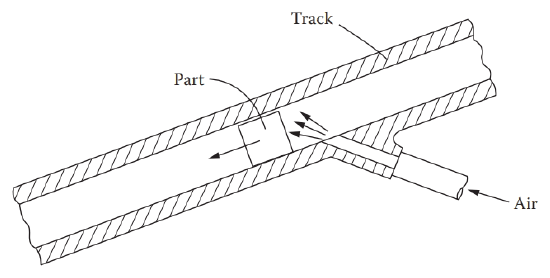 |
| Similar to the vibratory bowl feeder: an electromagnet and inclined springs give the track a vibration angle \(\Psi\) (Chapter 14). | Strategically positioned air jets drive the parts along the track. |
17.3 Escapements
Escapements let parts leave the feedtrack at the required rate, avoiding congestion at the workhead.
| Type | Description | Illustration |
|---|---|---|
| Work-carrier withdrawal | The assembly or work carrier draws the part from the track; usually a mechanism (a stop or spring blade) controls the rate of withdrawal. | 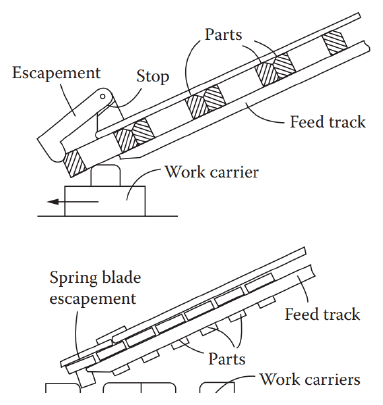 |
| Indexing table | The rotary indexing table itself acts as the escapement, with pockets for horizontal or vertical delivery. | 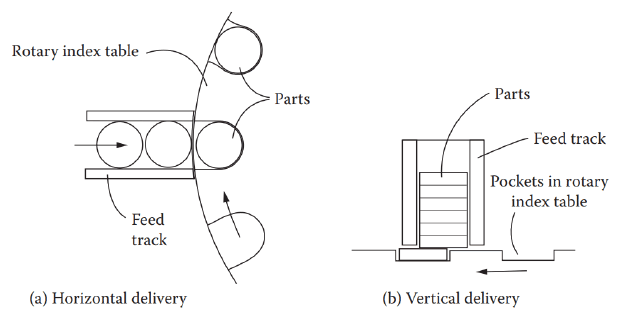 |
| Ratchet | Releases one part or several parts. The ratchet must not push parts back up the track, as this causes excessive loads and wear, and parts need suitable gaps at their outer edges when in single file. | 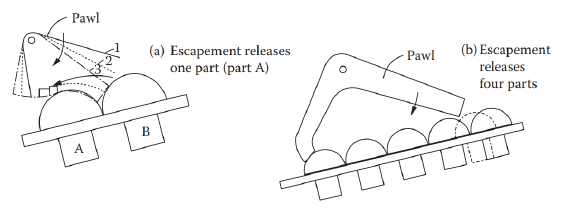 |
| Slide | For parts that don’t interlock: delivers one part or several. | 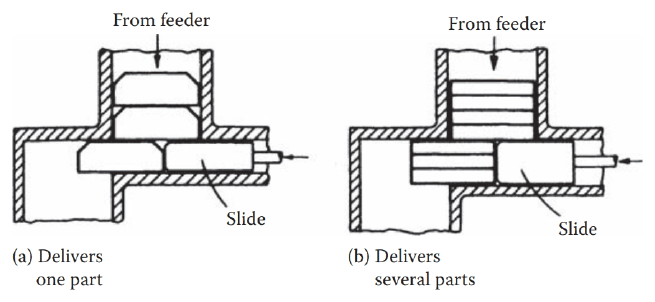 |
| Multiple workheads | One feeder can supply several workheads via a slide. | 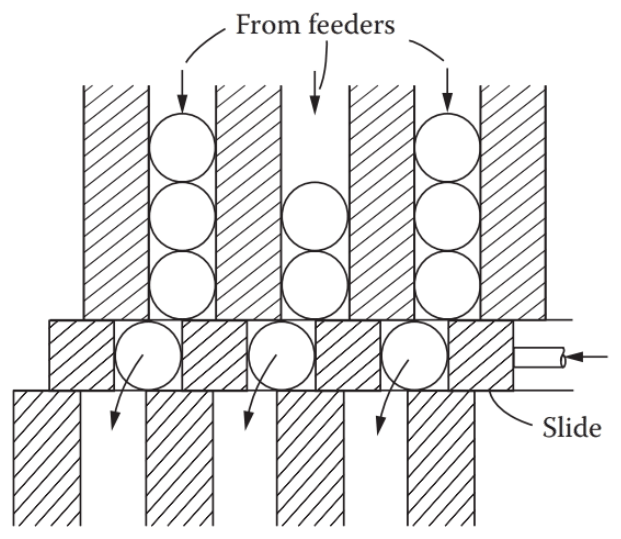 |
| Drum | Useful when a change of direction in a confined space is needed; the orientation angle of the delivered part can also be specified. | 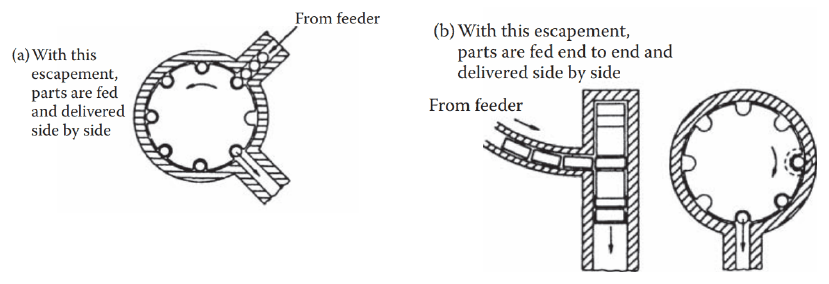 |
| Star wheel and worm | Rotary escapements that meter parts one at a time. | 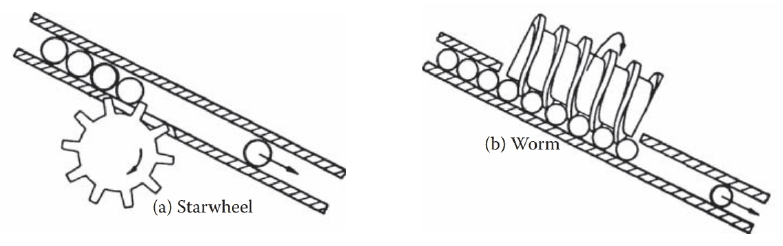 |
Key points
- Gravity tracks need to be kept full (use level sensors); vertical tracks give a constant rate, \(t = \sqrt{2L/g}\) per part.
- Track geometry raises the effective friction: \(\mu/\sin\theta\) for a V-track, and \(2\mu\) for 120° wires.
- Escapements meter parts to the workhead; choose one according to part shape, interlocking and space.
Interactive applets
Each applet runs in the page; use Open full screen for more room, or open all of this chapter’s applets together.
Applet 17.1 · Feedtrack level controller
A bowl feeds a track with adjustable high and low sensor positions while the workhead consumes parts at a set rate; plots of queue length, feeder on/off state and starvation events.
Teaches: Over-feeding vs level sensing; hysteresis between the sensors. · Open full screen ↗
Applet 17.2 · Track cross-section friction calculator
Pick a track type (flat, V with an adjustable angle, twin wires, three wires), enter \(\mu\), and get \(N\), \(F\) and \(\mu_{eff}\) from an interactive force diagram; then find the minimum inclination for a part to slide.
Teaches: The force-balance derivations. · Open full screen ↗
Applet 17.3 · Vertical drop-rate calculator
Enter the part length to get the time per part and the maximum feed rate, with a falling-parts animation.
Teaches: \(t = \sqrt{2L/g}\). · Open full screen ↗
Applet 17.4 · Escapement mechanism gallery
Animated ratchet, slide, drum, star-wheel and worm escapements, with a speed slider and a “jam” button that shows the failure mode (e.g. a ratchet pushing parts back up the track).
Teaches: How each mechanism isolates one part. · Open full screen ↗