Fieldbus, Profibus and Industrial Ethernet
Chapter 12 · Part III: Industrial Communications · Source: Lecture 10
Each network technology has a specific purpose. Industrial communication networks can generally be divided into those based on fieldbus and those based on Ethernet.
12.1 Fieldbus
A fieldbus connects sensors, actuators and the control computer. Several devices can be connected to one fieldbus and send their messages over the same line, so it must be specified who may exchange information, and when. Almost every PLC manufacturer has designed its own fieldbus, so there are many technologies that differ in, for example, maximum cable length, data rate or range of functions.
How a fieldbus works: master and slaves
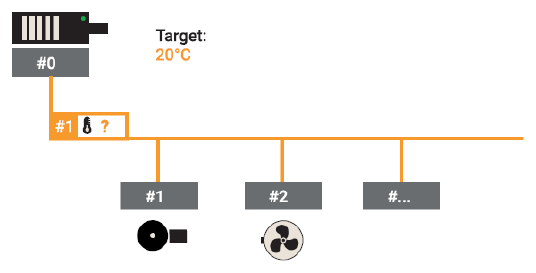
Figure 12.1: A master polls a temperature sensor and then commands a fan.
A fieldbus works on the master–slave principle:
- The master interrogates the sensor by sending it a request message.
- The sensor replies with its current value (e.g. temperature), which the controller processes.
- The master sends another message to the actuator containing the new set value (e.g. fan speed).
Since a fieldbus runs cyclically, like a PLC, the master then starts querying the sensor again.
Fieldbus vs conventional (point-to-point) wiring
| Advantages | Disadvantages |
|---|---|
| Easy to install: less wiring and smaller, simpler switch cabinets | Complexity needs qualified staff for operation and maintenance |
| Faster fault-finding when something fails | More elaborate measuring equipment needed |
| One cable for digital, binary and analogue signals | Longer response times because slaves are polled one after another (depending on the fieldbus) |
| Protection of analogue values from faults | Failure of the bus breaks communication between all components |
| The automated system can self-diagnose, e.g. sensor or actuator faults | |
| Simpler expansion or addition of sensors and actuators |
How fieldbus implementations differ
Each vendor’s proprietary fieldbus can be characterised by:
- Transmission medium: what type of cable (shielded or unshielded, number of wires)?
- Connectors: which connector types (depending on degree of protection and EMC requirements)?
- Topology: how are components connected?
- Maximum number of components: how many can the bus address?
- Power over the bus: can the cable carry power and data at the same time?
- Strengths and weaknesses of the bus in question.
12.2 Profibus
- PROFIBUS = PROcess FIeld BUS. Development began in 1987, and there is now a family of fieldbus variants.
- Siemens uses Profibus as the central bus for its controllers, which have a very large market share in Ireland and Europe.
- There are two main variants, differing in cable, connectors and interface:
- Profibus DP (Decentralised Periphery), for manufacturing automation
- Profibus PA (Process Automation), for process automation
| Profibus DP | Profibus PA | |
|---|---|---|
| Cable | 2-wire, shielded, twisted; conductor > 0.34 mm²; impedance 150 Ω. Fibre optic possible (multi-mode, single-mode, glass and plastic fibre) | 2-wire, shielded, twisted pair; conductor > 0.8 mm²; impedance 100 Ω |
| Topology | Line (copper, with active bus termination), star and ring | Line, star, or a combination |
| Extent | 100 m to 1200 m depending on data rate; up to 90 km with fibre | Up to 1900 m |
| Data rate | Up to 12 Mbit/s at 100 m; 9.6 kbit/s at 1200 m | 31.25 kbit/s (fixed) |
| Components | Max. 32 per segment, 126 in total | 126 |
| Power on bus | No | Optional, 9–32 V |
| Features | High speed compared with other fieldbuses; suits more complex components; extensive configuration options such as a variable data rate | Easy to combine with DP via a converter; designed for simple analogue sensors and actuators; fixed low speed, limited extent |
| Developer | Siemens / PNO / PI | Siemens / PNO / PI |
The slide prints the DP rate as “12.0 bit/s”; the standard maximum is 12 Mbit/s.
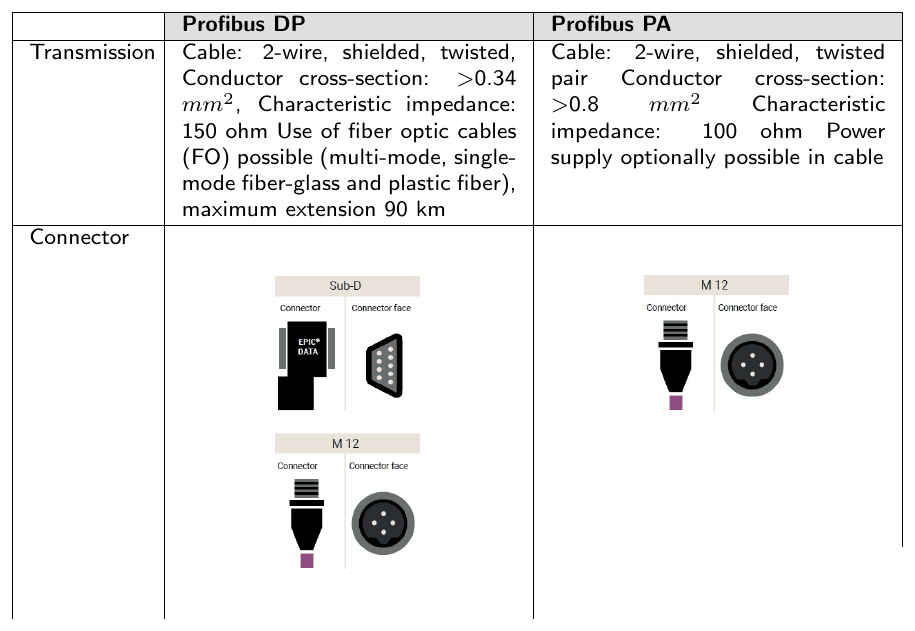
Figure 12.2: Profibus DP and PA transmission data and connectors (Sub-D and M12).
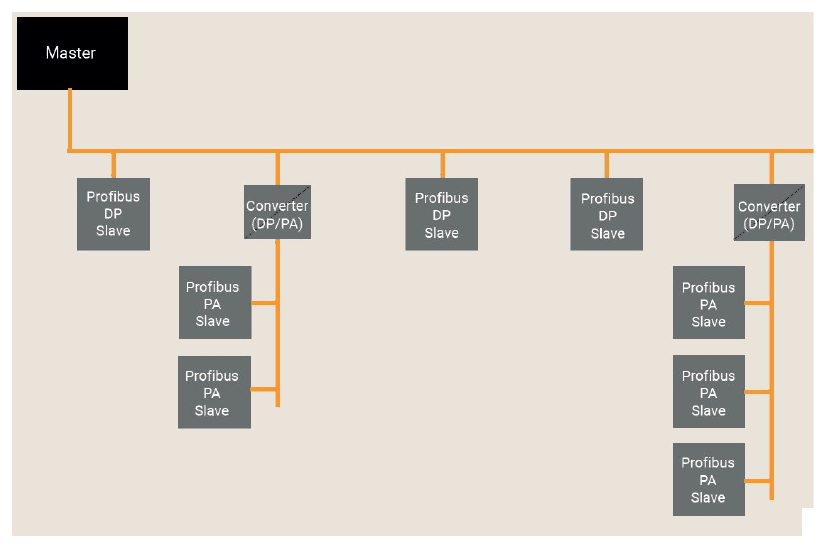
Figure 12.3: A Profibus DP master with DP slaves, and PA segments connected through DP/PA converters.
Other popular fieldbuses: CANopen, CC-Link, AS-Interface, IO-Link, MODBUS.
MODBUS TCP is among the most popular versions of MODBUS. Because it runs over Ethernet it is technically not a fieldbus. As Industry 4.0 technologies become mainstream, the line between these groups is increasingly blurred.
12.3 Ethernet in industrial use
Operating principle
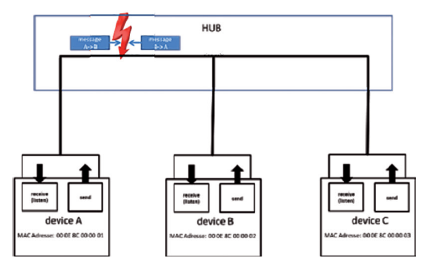
Figure 12.4: Ethernet devices are equal peers, and messages can collide.
Unlike the master–slave method of fieldbuses, all Ethernet devices are equal, so collisions can happen when messages are exchanged. A “listening” mechanism in each device detects whether another device is sending and waits accordingly. Under the IEEE standard, Ethernet communication is random and therefore not deterministic, which affects its use in industry.
Industrial Ethernet vs office Ethernet
- Environment: network components (cable, plugs, switches) need a higher protection class to withstand dust, splashing water, lubricants and acid, plus better electromagnetic-interference resistance and a wider temperature range.
- Network: offices mainly use star topologies; industry tends to use line topologies (daisy-chaining devices). For high fail-safety, components must be very reliable and the network itself needs precautions (ring closures, redundancy). Because the network must be deterministic and as fail-safe as possible, “controlled” communication is required.
Categories of Industrial Ethernet
- Standard IP communication: IP-based, like office communication. The drawback is that the classic real-time properties of fieldbuses can’t be achieved.
- Standard Ethernet communication: communication uses standard Ethernet messages directly, with components addressed by MAC address.
- Proprietary Ethernet communication: uses parts of the Ethernet standard plus manufacturer-specific software and hardware extensions to give a deterministic response. For example, an Ethernet message carries special information processed by proprietary hardware (e.g. a slave component). Cycle times below 1 ms are possible.
Figure 12.5: Common Industrial Ethernet systems.
Fieldbus vs Ethernet
| Advantages of fieldbus over Ethernet | Advantages of Ethernet-based networks |
|---|---|
| Deterministic | Faster |
| More economical | Same network for IT and automation |
| Straightforward installation needing less wiring | More topology options |
| Easier calibration of instruments | Wide range of network analysis tools |
| Access to more data: measurement and diagnostic | Easier to expand |
| Easier troubleshooting | Readily available technical support |
| Less sensitive to electrical noise | Universal connectivity to controllers, I/O and other components |
| More physically robust connectors and components | Can carry multiple protocols at once |
| Easier to transmit power over the network | Superior, rapidly improving price/performance |
| Spans longer distances without repeaters or switches | Easier integration with wireless networks |
Key points
- A fieldbus is master–slave and cyclic, which makes it deterministic; standard Ethernet is peer-to-peer and random.
- Profibus DP is fast and flexible; Profibus PA is low-speed and can power simple process instruments over the bus.
- Industrial Ethernet systems (PROFINET, EtherCAT, EtherNet/IP…) add proprietary extensions to get deterministic, sub-millisecond behaviour.
Interactive applets
Each applet runs in the page; use Open full screen for more room, or open all of this chapter’s applets together.
Applet 12.1 · Master–slave polling simulator
Add slaves to a bus and set the baud rate and message size; watch the master poll each slave in turn and see the cycle time grow with the number of slaves.
Teaches: Determinism vs response time; why many slaves slow a fieldbus. · Open full screen ↗
Applet 12.2 · Collision vs determinism race
Run the same traffic load on (a) a shared Ethernet with random back-off and (b) a polled fieldbus; plot latency histograms (Ethernet has a long tail, fieldbus a tight spike).
Teaches: Why standard Ethernet isn’t deterministic. · Open full screen ↗
Applet 12.3 · Profibus cable length vs data rate chart
Drag a slider for cable length and see the maximum DP data rate (12 Mbit/s at 100 m down to 9.6 kbit/s at 1200 m), with a toggle to fibre.
Teaches: The rate/length trade-off. · Open full screen ↗
Applet 12.4 · Wiring comparison: conventional vs fieldbus
Place 20 sensors and actuators on a machine and compare cable runs, cabinet size and failure points with point-to-point wiring vs one bus.
Teaches: The advantages and disadvantages table. · Open full screen ↗
Applet 12.5 · Choose-a-network quiz
Given scenarios (a hazardous-area pressure transmitter, a high-speed motion axis, an office MES link), pick Profibus PA, Profibus DP, PROFINET IRT/EtherCAT or standard Ethernet.
Teaches: Applying the comparison criteria. · Open full screen ↗