Lecture 15: Speed–Torque Curve
Recap: Power and Torque in the Induction Motor
The first part of this lecture revisits the power and torque analysis of the induction motor equivalent circuit, and the two worked examples (the 400 V, 25 kW star-connected motor and the 22.37 kW, 440 V delta-connected motor). That material is covered in full in Lecture 14: Power and Torque and is not repeated here. The key results are:
\[ \frac{R_r'}{s} = R_r' + \frac{1 - s}{s}R_r', \qquad P_{ag} = 3I_r'^2\frac{R_r'}{s}, \qquad P_r = sP_{ag}, \qquad P_{dev} = (1 - s)P_{ag} \]
\[ P_{out} = P_{dev} - P_{rot}, \qquad \eta = \frac{P_{out}}{P_{in}}, \qquad T_{dev} = \frac{P_{dev}}{\omega_r} = \frac{P_{ag}}{\omega_s} \]
Note on the worked example. This lecture’s version of the 25 kW example corrects two of the errors in Lecture 14’s slides (\(Z_r + Z_s = 5.8 + j0.95\ \Omega\), and the copper losses), but it still divides the power by the speed in rpm when calculating the torque, giving 15.4 N·m. With the speed in rad/s the output torque is about 150 N·m. The fully corrected solution is in Lecture 14, Worked Example 1, and Worked Example 2 gives the solution of the 22.37 kW exercise.
The Speed–Torque Curve
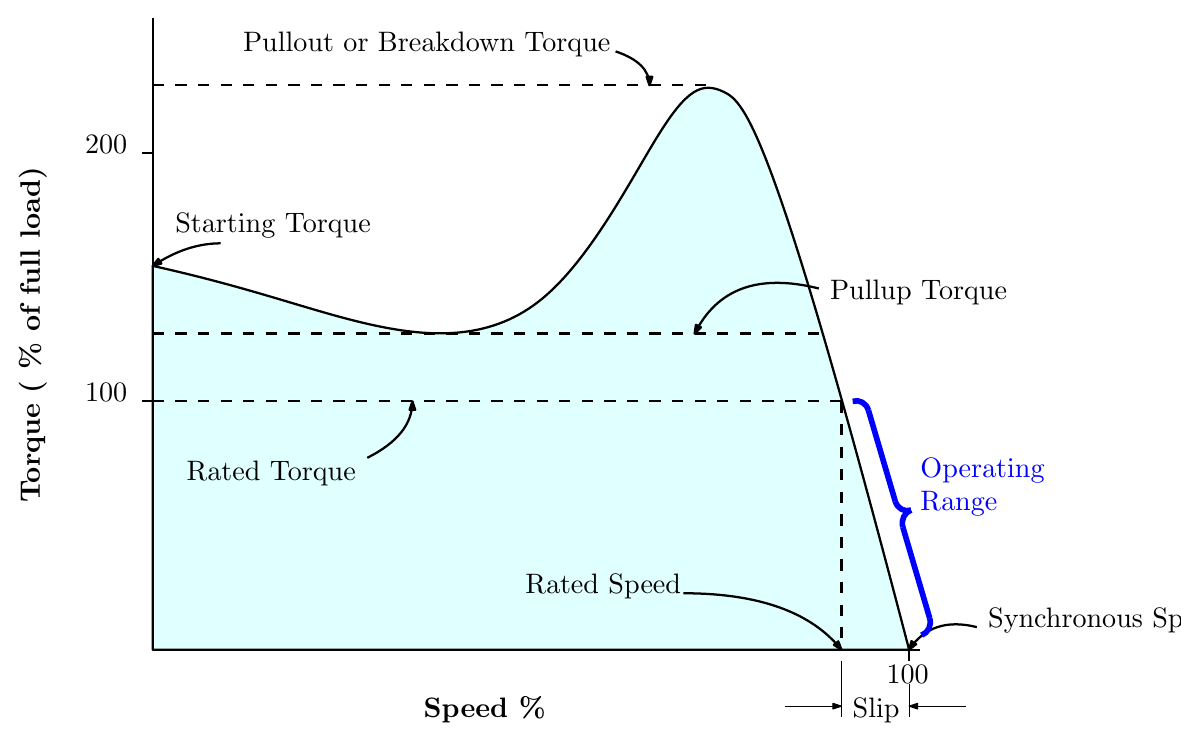
The speed–torque curve of an induction motor is non-linear from start-up to operating speed, but it is relatively linear about the operating point: on the steep section just below synchronous speed, the torque rises roughly in proportion to the slip.
There are four key torque points:
- Starting torque (also called locked-rotor torque)
- Pull-up torque
- Pull-out torque (breakdown torque)
- Rated torque (full-load torque)
The Four Key Torque Points
1. Starting torque
The locked-rotor, breakaway or starting torque is the torque the motor develops when starting at zero speed. It is normally expressed as a percentage of full-load torque, and is typically about 1.5 times the rated torque.
All motors can safely produce more than their rated full-load torque for short periods. Many loads need more torque to start them moving than to keep them moving, so a motor must produce a higher torque when starting.
- A high starting torque matters for machines that are hard to start, such as positive displacement pumps and cranes.
- A lower starting torque is acceptable for centrifugal fans or pumps, where the starting load is low or close to zero.
2. Pull-up torque
The pull-up torque is the minimum torque the motor develops as it runs up from zero to full-load speed, before it reaches the breakdown torque.
As the motor starts and accelerates, the torque generally falls to a low point (the pull-up torque) at a certain speed, then rises to the highest torque (the breakdown torque) at a higher speed.
The pull-up torque can be critical for applications that must push through temporary resistance before reaching working conditions. If the motor is properly sized for the load, the pull-up period is brief.
3. Pull-out (breakdown) torque
The pull-out or breakdown torque is the highest torque available before the torque falls as the machine continues to accelerate to working conditions.
As the load on the shaft increases, the motor produces more torque. If the load keeps increasing, it eventually reaches the point at which the motor stalls: the breakdown torque. It is the maximum torque a motor can provide without an abrupt reduction in speed.
4. Full-load (rated) torque
The full-load torque is the torque required to produce rated power at full-load speed, with the motor at its rated voltage, frequency and load. At full-load torque the motor runs slightly below synchronous speed, by the slip. Reducing the torque below the rated value lets the speed rise closer to synchronous speed.
Notes
- The shape of the curve is indicative: the relative values vary from motor to motor. For example, the starting torque could be much closer in magnitude to the pull-up torque.
- The curve for a particular motor is found from a series of tests: (1) the DC test, (2) the no-load test and (3) the locked-rotor test. The details of these tests are beyond the scope of this module.
- The next lecture looks at motor design classes, which differ in the shape of this curve.
Interactive Elements
Each element below runs in the page; use Open full screen for more room.
Speed–torque curve with a load line
The motor’s curve and a load’s torque curve (constant torque, fan or pump, or a hard-to-start load) on the same axes. The motor accelerates while its torque exceeds the load’s, and settles where they cross. Increasing the load moves the operating point down the steep section until, past the pull-out torque, the motor stalls.
Curve from the equivalent circuit
Generate the curve from the Lecture 14 equivalent circuit, \(T = \dfrac{3V^2R_r'/s}{\omega_s\big[(R_s + R_r'/s)^2 + (X_s + X_r')^2\big]}\), with sliders for \(V\) and \(R_r'\). Students see that the breakdown torque is set by the reactances, that it moves to higher slip as \(R_r'\) grows, and that torque scales with \(V^2\).
Label the curve
A drag-and-drop exercise placing “starting”, “pull-up”, “pull-out”, “rated”, “synchronous speed” and “slip” on a blank curve.
Knowledge Check
Q1. Name the four key torque points on an induction motor’s speed–torque curve.
Answer
Starting (locked-rotor) torque, pull-up torque, pull-out (breakdown) torque, and rated (full-load) torque.
Q2. What is the pull-out (breakdown) torque, and what happens if the load exceeds it?
Answer
It is the maximum torque the motor can develop. If the load torque exceeds it, the motor can no longer hold its speed: it slows abruptly and stalls.
Q3. Typically, how does the starting torque compare with the rated torque?
Answer
It is about 1.5 times the rated (full-load) torque, although this varies between motors.
Q4. Would a high starting torque be more important for a centrifugal fan or for a crane? Why?
Answer
For a crane. It must lift its full load from rest, so it needs a high torque at zero speed. A centrifugal fan needs almost no torque at low speed, so a low starting torque is acceptable.
Q5. What is the pull-up torque, and when does it matter?
Answer
The minimum torque the motor develops while accelerating from rest to full speed. It matters if the load needs a high torque partway through run-up: if the load torque exceeds the pull-up torque, the motor will hang at that speed instead of reaching full speed.
Q6. Why is the speed–torque curve described as relatively linear about the operating point?
Answer
At small slip, the rotor resistance term \(R_r'/s\) dominates the rotor impedance, so the rotor current, and hence the torque, is roughly proportional to the slip. The curve is therefore nearly a straight line just below synchronous speed.
Q7. As the load on an induction motor is reduced from full load, what happens to its speed?
Answer
The slip decreases, so the speed rises towards (but never reaches) synchronous speed.
Q8. Which three tests are used to find the parameters, and hence the speed–torque curve, of a particular motor?
Answer
The DC test, the no-load test and the locked-rotor test.