Lecture 18: Motor Starting
Motor Selection
Having covered the different motor types, we now look at how to select a motor. There is a large variety of factors to consider, and three problems to overcome:
- In most cases two or more types of motor would suit our needs, so we have to make a choice rather than have it made for us.
- It is not always simply a matter of matching the motor to the load when running; there is also starting the load. Can the starting torque accelerate the load, and is the acceleration time short enough?
- Some limitations apply whatever the type of motor. For instance, can the motor operate under water, in hot surroundings, or in a dusty atmosphere?
The following sections describe some of the more important factors.
Speed
- Most electric motors run at quite high speeds, say 500 to 3000 rpm.
- Some motors operate within a narrow speed range around an ideal operating point; for example an induction motor might run between 1430 and 1470 rpm depending on load.
- Often the easiest way to change the nominal speed is with mechanical gears.
- DC motors with series field windings accept wide speed variation; methods for varying their speed, such as field and armature diverters, were covered in Lecture 5.
- Techniques for controlling the speed of cage-rotor induction motors are covered below (see the variable frequency drive).
Power Rating and Duty Cycles
A motor is expected to run continuously at its rated power. The rating depends on the motor’s ability to dissipate waste heat: the heat from the \(I^2R\) losses in the windings, the eddy current losses in the rotor and stator cores, and windage and friction.
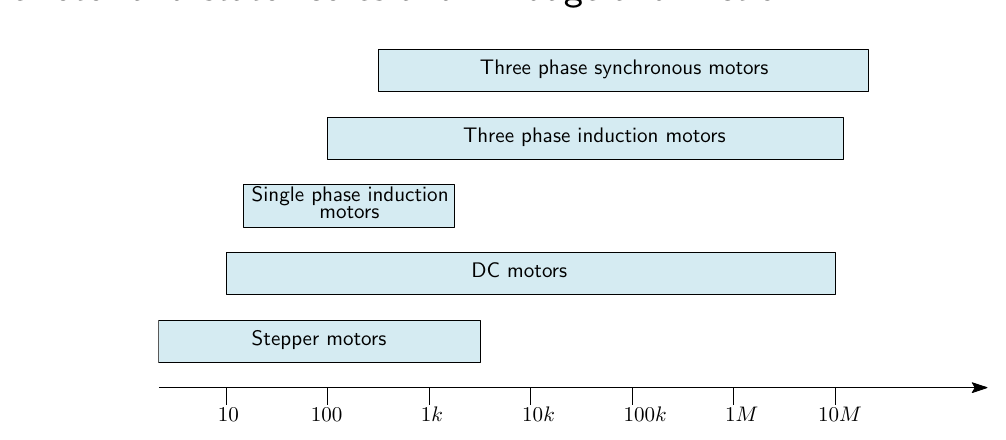
| Motor type | Typical power range (approximate, from the chart) |
|---|---|
| Stepper motors | About 10 W to 1 kW |
| Single-phase induction motors | About 100 W to a few kW |
| DC motors | About 100 W to several MW |
| Three-phase induction motors | About 1 kW to several MW |
| Three-phase synchronous motors | About 10 kW to 10 MW |
Because the rating is thermal, a motor can be overloaded for a short time: a 10 kW motor could deliver 20 kW for a very short period (say 1 or 2 minutes), or 11 kW for an hour. Motors for such cyclical duties are often available in standard forms for duty periods such as 10, 30 or 60 minutes.
Load Torques
Load torques fall into two broad categories:
- constant torque;
- fan- or pump-type torque.
Constant-torque loads
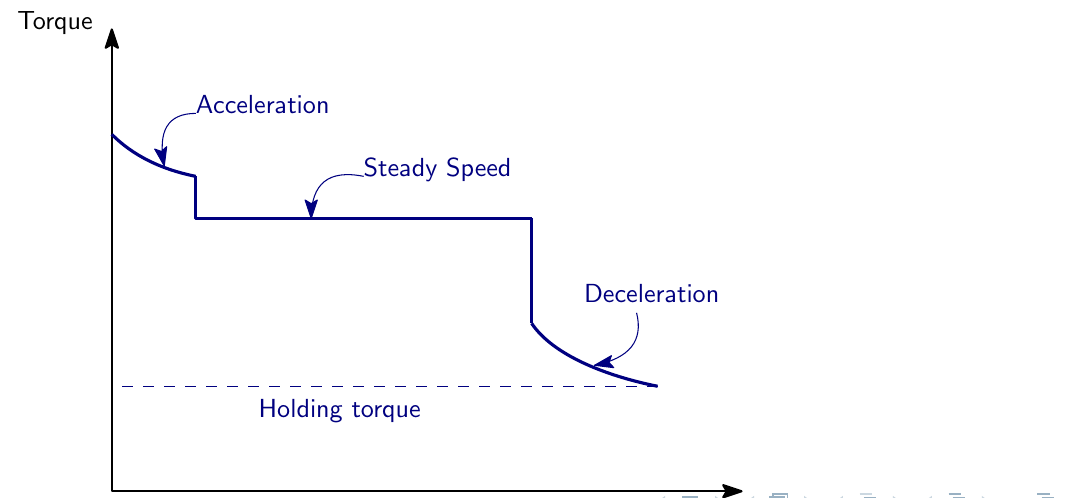
A passenger lift is an example of a constant-torque load. A constant-torque description does not usually account for acceleration from standstill: to start the lift rising, extra torque is needed, and the greater the desired acceleration, the greater the torque. The motor must also produce torque at standstill to hold the lift in place.
Fan and pump loads
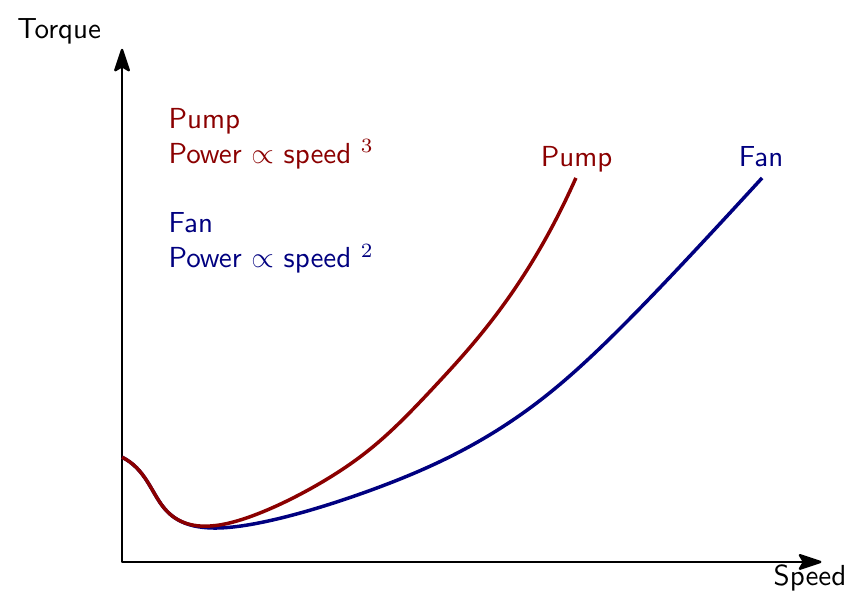
For a fan or pump, the whole load comes from driving air (a fan) or a fluid (a pump). The slide labels the fan’s power as proportional to (speed)² and the pump’s as approaching (speed)³.
Note. For both fans and centrifugal pumps, the standard relationships (the fan and pump affinity laws, also used in Lecture 16) are that the torque is proportional to (speed)² and so the power is proportional to (speed)³. The practical point is the same: the load is very light at low speed, so these loads are easy to start.
Operating Environment and Efficiency
Operating environment
One factor is independent of the motor’s circuitry: the environment it must operate in. Four aspects are considered:
- ingress of materials (dust and solids);
- ingress of water;
- the cooling arrangement;
- the cooling circuit power.
(The first two are graded by the IP (ingress protection) rating, for example IP55: the first digit for solids, the second for water.)
Efficiency
Ideally the power into a machine would equal the power out. In practical motors it does not, and the output varies with the load. We need to be able to predict these changes to anticipate how a motor will perform under load (see the efficiency calculations in Lectures 2 and 14).
Motor Starting
- A motor starter is an electrical device used to start and stop a motor safely.
- The slip of an induction motor is at its maximum (\(s = 1\)) at standstill, so its impedance is at its minimum.
- The low impedance results in a very large initial current, called the inrush current: typically 5–8 times the rated full-load current.
- As the rotor speeds up, the slip falls and the current drawn by the motor drops.
- Such a current can damage or burn out the motor windings, and it can cause a large voltage dip on the supply line that can affect other equipment on the same line.
Direct-on-Line (DOL) Starter
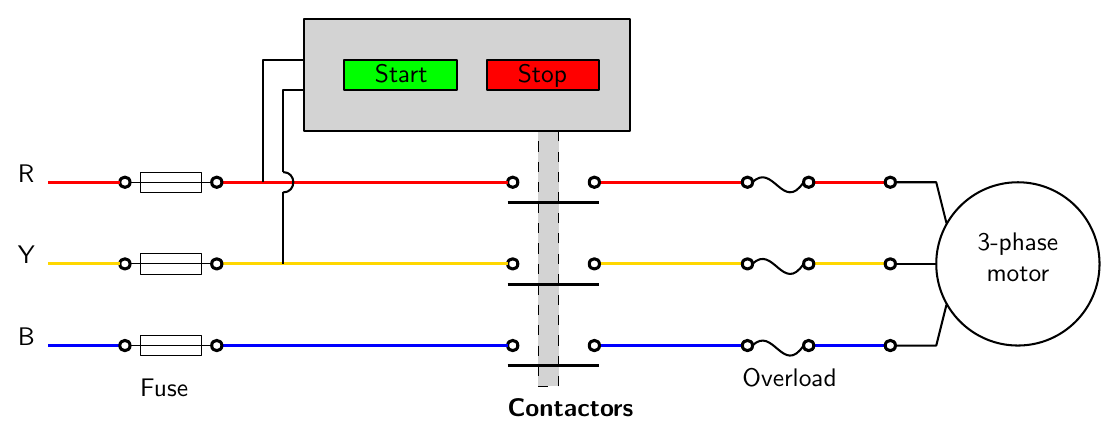
- The direct-on-line starter is the simplest form of starter: it connects the motor directly to the supply.
- There is no voltage reduction to soften the start.
- Pressing the start button energises a coil that pulls the contactors closed; pressing the stop button de-energises the coil.
| Advantages | Disadvantages |
|---|---|
| Very simple and cost-effective | The high inrush current can damage the windings |
| Very easy to understand and operate | The inrush current causes a voltage dip on the supply |
| High starting torque, due to the high starting current | Not suitable for large motors |
| Can shorten the life of the motor |
Star–Delta Starter
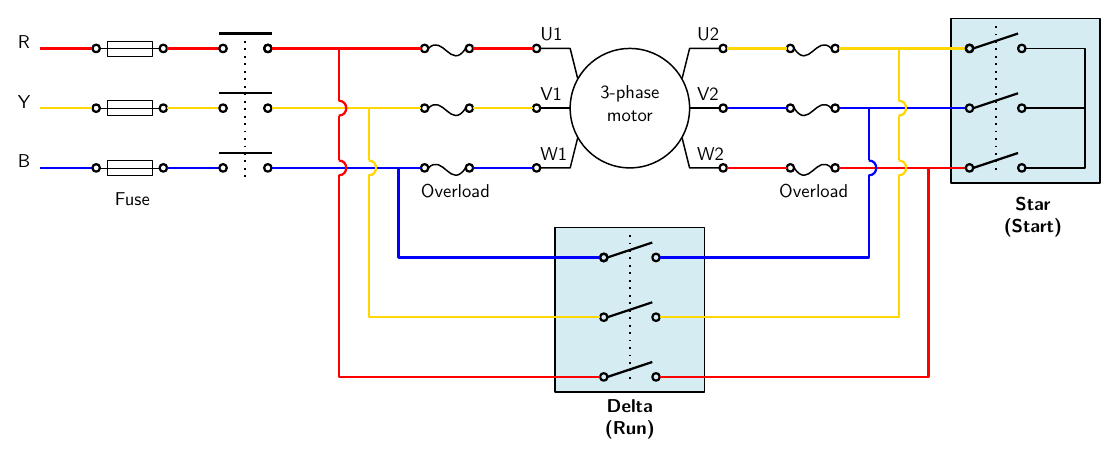
- To start, the motor windings are connected in star. Each winding then has \(\dfrac{1}{\sqrt{3}}\) of the line voltage across it, which reduces the starting current and the starting torque.
- As the motor accelerates, a timer or relay switches the windings to delta, putting the full line voltage across each winding.
- The motor then runs at its rated speed.
Since the torque is proportional to the square of the voltage, starting in star reduces both the line current and the starting torque to one third of their direct-on-line values:
\[ \frac{V_{star}}{V_{delta}} = \frac{1}{\sqrt{3}} \quad \Rightarrow \quad \frac{T_{star}}{T_{delta}} = \left(\frac{1}{\sqrt{3}}\right)^2 = \frac{1}{3} \]
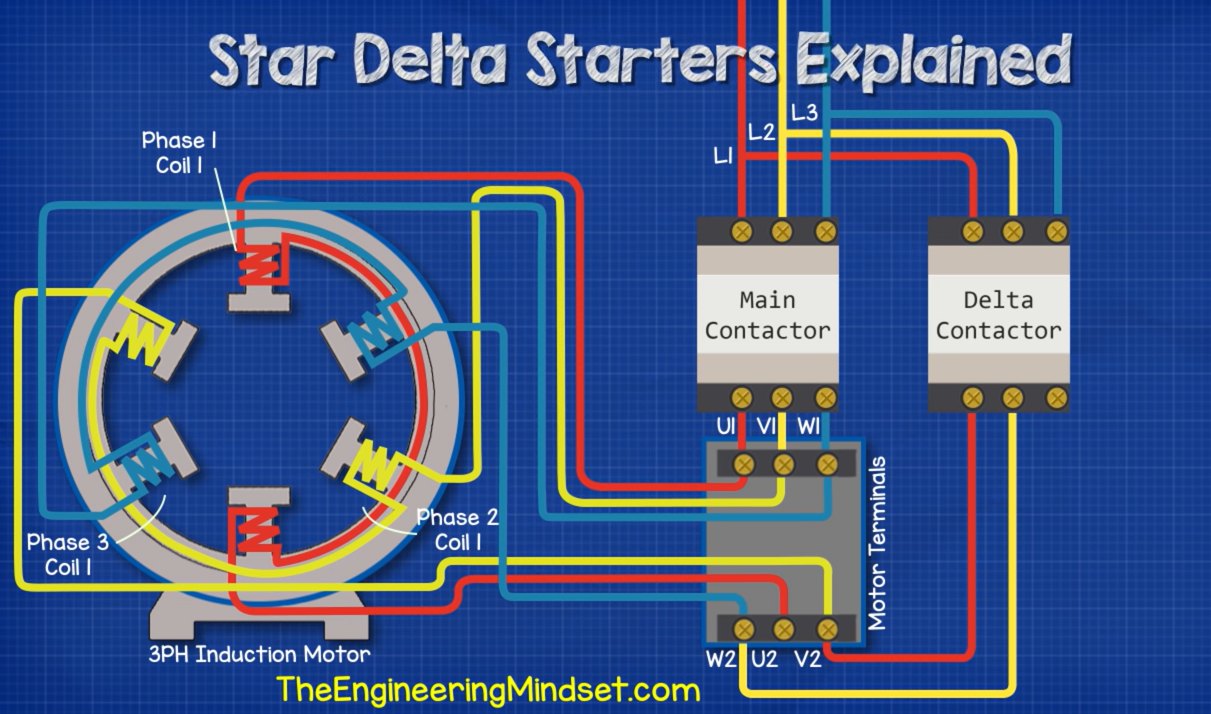
Engineering Mindset video: “Star Delta Starters Explained”.
| Advantages | Disadvantages |
|---|---|
| Simple and cheap design | Only works with motors designed to run in delta (six terminals brought out) |
| Requires no maintenance | More wiring connections |
| Low surge current | Low starting torque (one third of DOL), which cannot be adjusted |
| Used for starting large induction motors | Very limited flexibility in starting characteristics |
| Suits long acceleration times | A mechanical jerk (and current surge) when switching from star to delta |
Soft Starter
TRIAC phase control
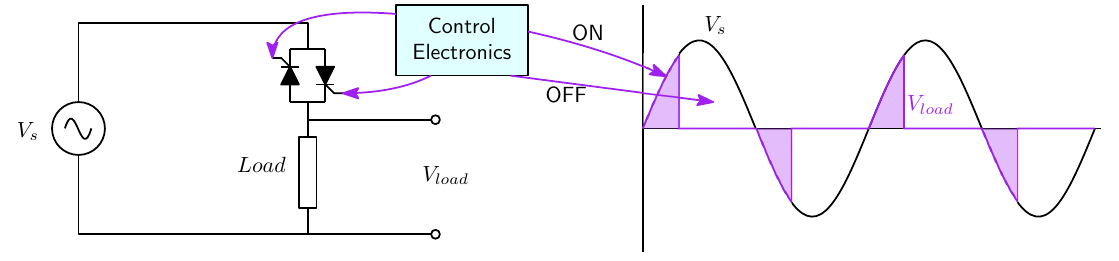
Before looking at the soft starter, a brief look at the TRIAC and how it is used:
- A TRIAC is an electronically triggered switch for AC.
- An ordinary diode only lets current flow in one direction. A TRIAC blocks current in both directions until a control signal is applied to its gate; it then conducts until the current falls to zero at the end of that half cycle.
- The control electronics decide when, within each half cycle, to send the gate signal. Varying this changes the conduction angle: the fraction of each 180° half cycle that reaches the load.
- In the figure, only the purple part of each half cycle reaches the load, so the average voltage across the load is reduced.
The slide describes the TRIAC as “an electronically controlled diode” that conducts only when the current flows in the appropriate direction; more precisely, a TRIAC can conduct in either direction once triggered, which is why it can control both halves of the AC cycle.
The soft starter
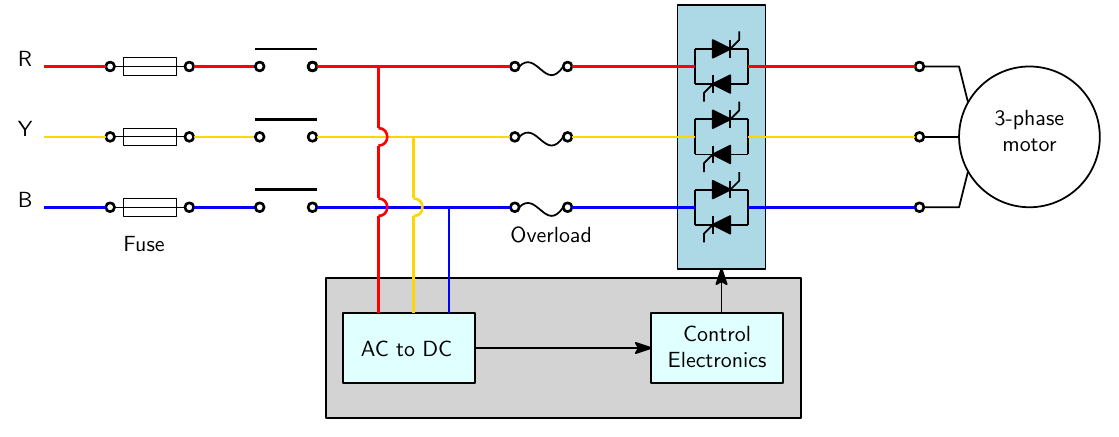
- The soft starter also uses voltage reduction.
- It uses switches such as TRIACs to control the voltage supplied to the motor.
- The voltage is increased gradually by increasing the conduction angle.
- This gives a gradual, smooth increase in the starting voltage, current and torque.
- There is no mechanical jerk, and the smooth operation increases the life of the machine.
| Advantages | Disadvantages |
|---|---|
| Better control of starting current and voltage | Relatively expensive |
| Smooth acceleration, with no jerks | Energy is dissipated as heat in the switches |
| Reduces power surges in the system | |
| Extends the life of the system | |
| Good efficiency, little maintenance | |
| Relatively small |
Variable Frequency Drive (VFD)
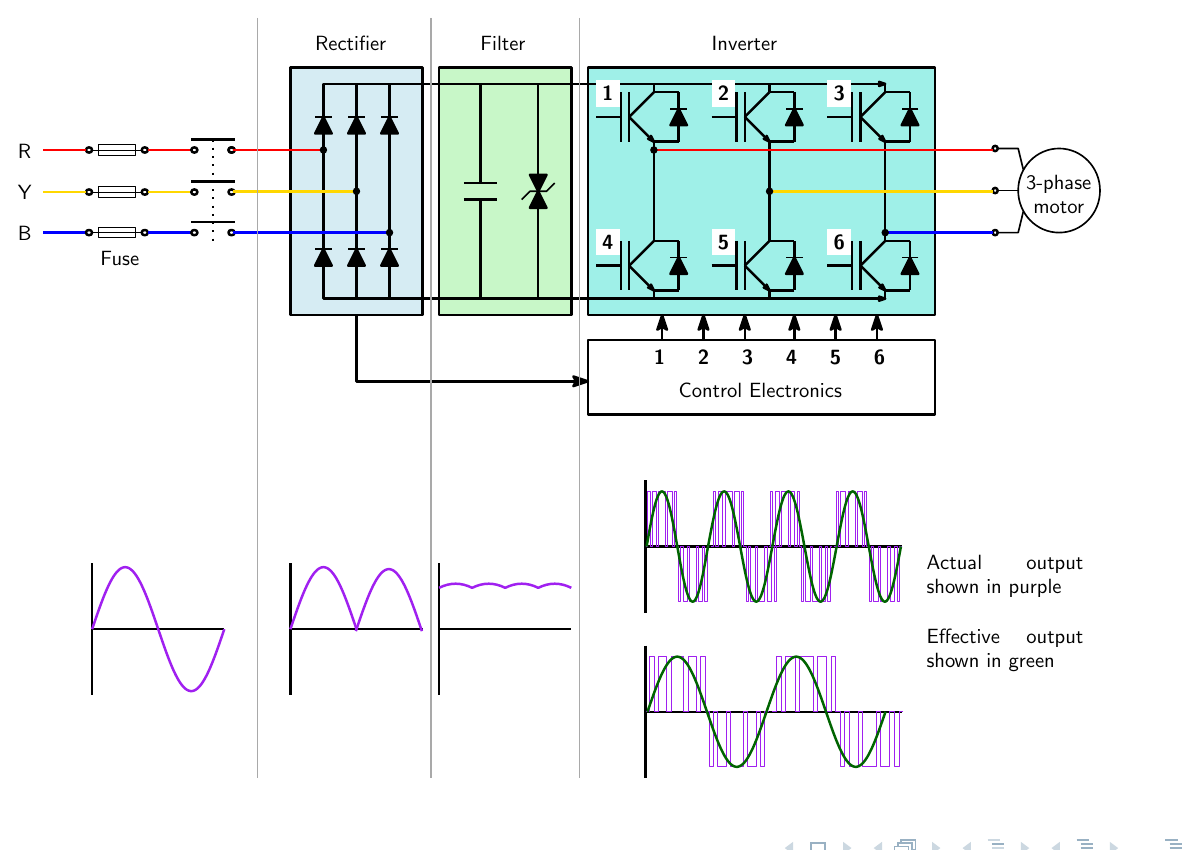
- The AC supply is converted to DC by a rectifier, smoothed by a filter, then converted back to AC by an inverter, with adjustable frequency and voltage, using pulse width modulation (see Lecture 5). The actual output is a series of pulses (purple); its effective value is a sine wave (green).
- Because the synchronous speed is \(N_s = \dfrac{60f}{p}\), varying the frequency gives full control of the motor speed, from zero to rated speed (and above).
- Adjusting the voltage with the frequency gives a lower starting current and better acceleration.
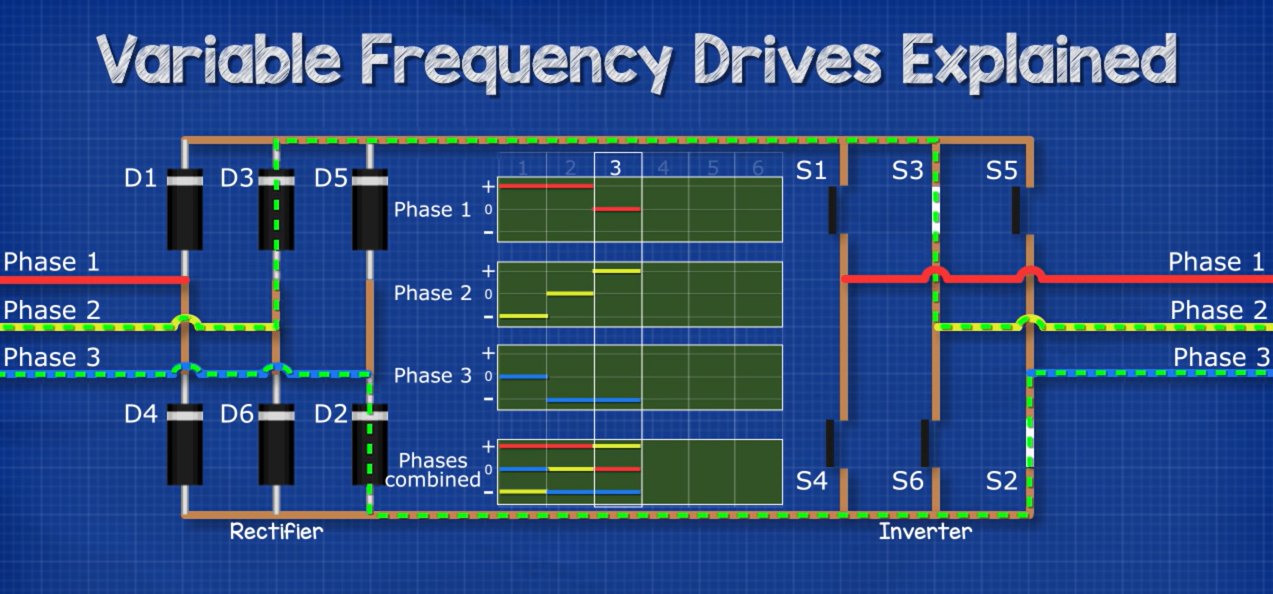
Engineering Mindset video: “Variable Frequency Drives Explained”.
| Advantages | Disadvantages |
|---|---|
| Better, smoother acceleration for large motors | Relatively expensive, unless speed control is needed anyway |
| Full speed control, with smooth acceleration and deceleration | Heat dissipation |
| Longer life, with no electrical or mechanical stress | Creates harmonics on the supply, which can affect electronic equipment and the power factor |
| Forward and reverse operation |
Comparison of Starting Methods
| DOL | Star–delta | Soft starter | VFD | |
|---|---|---|---|---|
| Starting current | 5–8 × full load | About ⅓ of DOL | Adjustable, reduced | Low, controlled |
| Starting torque | High | About ⅓ of DOL | Adjustable, reduced | High torque available at low speed |
| Smoothness | Abrupt | Jerk at the changeover | Smooth | Smooth |
| Speed control when running | No | No | No | Yes |
| Cost and complexity | Lowest | Low | Medium | Highest |
Interactive Elements
Each element below runs in the page; use Open full screen for more room.
Starting-method comparison
Choose DOL, star–delta, soft starter or VFD and watch the start-up of an induction motor driving a chosen load (fan, pump, conveyor or lift): the motor current, torque and speed against time, with the inrush current, the star–delta changeover jerk and the soft starter’s ramp visible, and a supply-voltage dip indicator.
Starter circuits
A live simulation of each starter driving a pump: DOL with its Start/Stop control circuit and hold-in contact, star–delta with its changeover timer, the soft starter with its thyristor ramp and bypass (or a manual gate firing-angle slider, with the chopped waveform drawn), and the VFD with the six-diode rectifier, DC link and six-switch inverter drawn out (plus a frequency slider). Start and Stop are spring-return pushbuttons that act only while held. Current is animated along whichever paths are complete as the contacts make and break, and the motor speed and line current are plotted against time.
TRIAC conduction angle
A slider for the firing angle with the resulting chopped waveform and rms output voltage; ramping it shows how a soft starter raises the voltage.
VFD and PWM
Set the output frequency and see the PWM pulses and the filtered sine wave, with the synchronous speed \(N_s = 60f/p\) and the motor’s speed–torque curve sliding along the speed axis as the frequency changes (with constant V/f).
Duty-cycle thermal model
Run a motor at various overloads for chosen times and watch a simple winding-temperature model rise towards its limit, showing why a 10 kW motor can deliver 20 kW for a minute or two but not for long.
Motor selection quiz-tool
Enter the load type, power, speed, starting requirements and environment, and get a short-list of suitable motor types and starters with reasons.
Knowledge Check
Q1. Give the three problems the lecture identifies in selecting a motor.
Answer
- Usually more than one type of motor is suitable, so a choice must be made; (2) the motor must be able to start and accelerate the load, not just run it; (3) there are limitations that apply whatever the motor type, such as operating underwater, in heat or in dust.
Q2. Why is a motor’s power rating essentially a thermal rating, and what does this mean for short overloads?
Answer
The rating is set by how well the motor can get rid of the heat from its losses (\(I^2R\), eddy currents, friction and windage). Because the windings take time to heat up, a motor can be overloaded for short periods (for example a 10 kW motor delivering 20 kW for a minute or two) as long as the temperature limit is not exceeded.
Q3. Why does an induction motor draw a very large current when started direct on line?
Answer
At standstill the slip is 1, so the rotor resistance term \(R_r'/s\) is at its smallest and the motor’s impedance is at its minimum. The current is limited only by the winding impedance: typically 5–8 times the full-load current.
Q4. By how much does a star–delta starter reduce the starting current and starting torque compared with DOL, and why?
Answer
To about one third. In star, each winding has \(1/\sqrt{3}\) of the line voltage. The phase current falls by \(1/\sqrt{3}\), and because the line current in delta is \(\sqrt{3}\) times the phase current, the line current falls to a third; torque is proportional to voltage squared, so it also falls to \((1/\sqrt{3})^2 = 1/3\).
Q5. Why would a star–delta starter be a poor choice for a conveyor that must start fully loaded?
Answer
It reduces the starting torque to about a third of the DOL value, which may not be enough to start a fully loaded conveyor. A soft starter with adequate torque, or a VFD, would be better.
Q6. How does a soft starter reduce the voltage applied to the motor?
Answer
It uses TRIACs (or back-to-back thyristors) fired partway through each half cycle. Increasing the conduction angle (firing earlier) gradually increases the voltage until full voltage is applied.
Q7. Describe the three stages of a variable frequency drive.
Answer
A rectifier converts the AC supply to DC; a filter (capacitor) smooths the DC; an inverter switches the DC using PWM to produce AC of adjustable frequency and voltage for the motor.
Q8. How does a VFD control the speed of an induction motor?
Answer
By changing the supply frequency, which changes the synchronous speed \(N_s = 60f/p\); the motor runs just below this. The voltage is adjusted with the frequency (keeping V/f roughly constant) to keep the flux, and so the torque capability, constant.
Q9. Give one disadvantage of a VFD that does not apply to the other starters.
Answer
It injects harmonics into the supply, which can disturb other electronic equipment and worsen the power factor. (It is also the most expensive option.)
Q10. What four environmental aspects are considered when selecting a motor?
Answer
Ingress of materials (solids and dust), ingress of water, the cooling arrangement, and the cooling circuit power.
Q11. A lift motor must produce torque at standstill. Which of the starting methods covered can also hold the load and control speed, and why?
Answer
A VFD: it can produce controlled torque at zero and low speed and allows smooth acceleration, deceleration and positioning, which the fixed-frequency starters (DOL, star–delta, soft starter) cannot. (Lifts also use a mechanical brake to hold the load.)