Introduction to Industrial Logic Control
Chapter 1 · Part I: Logic Control Fundamentals · Source: Lecture 1
1.1 Recommended texts
- Robotics and Manufacturing Automation, C. Ray Asfahl (670.427/ASF)
- Assembly Automation and Product Design, Geoffrey Boothroyd (670.427/BOO)
- Computer Automation in Manufacturing: An Introduction, Thomas O. Boucher (670.427/BOU)
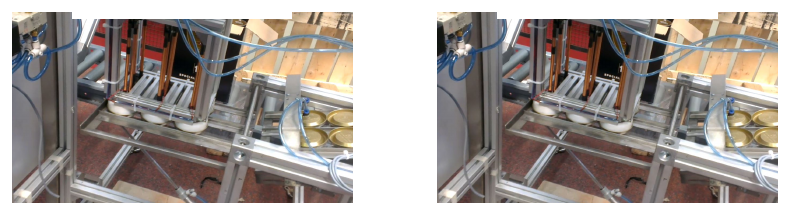
Figure 1.1: A sample automated system. Videos 1 and 2 are linked from the original slide.
1.2 Scope of these notes
These notes cover two of the module’s areas, regrouped by topic rather than by lecture:
- Automation for industrial logic control systems: logic analysis, logic and network diagrams, response diagrams, programmable logic controllers (PLCs), ladder logic, SCADA and industrial networks.
- Automated assembly and parts feeding: transfer systems, part feeding devices, orientation, feed tracks and escapements, assembly line performance and cost justification.
The module’s third area, Statistical Process Control (SPC), is not covered in these notes.
1.3 Industrial logic control systems
Three types of control system are commonly used in industry:
- Programmable logic controllers (PLCs), such as the Siemens S7-1200 used in this course
- Digital electronics
- Logic control systems
These systems automate production processes and implement quality control (QC) systems.

Figure 1.2: Siemens S7-1200 PLC.
Decisions by attributes and by variables
Automation decisions are taken based on inputs, which fall into two categories:
| Category | Description | Examples |
|---|---|---|
| Decision by attributes | The measured input has a discrete value | high/low, large/medium/small, round/square, black/white, 1/0, yes/no |
| Decision by variables | The measured input can take any value within a range | 25.4 °C, 1004 mbar, 100.2 g |
A control strategy is relatively easy to implement when decisions are based on attributes. A decision by variables can be converted into an attribute by applying a threshold:
- If \(t \le 100\) then output = ON
- If \(t > 100\) then output = OFF
The continuous range becomes the attribute of being below, or not below, the threshold.
Example: a furnace
Even apparently simple processes can lead to relatively complex control problems involving multiple logical relationships between variables. Consider a furnace used to preheat forged blanks:
- If the flame goes out, it must be reignited.
- If re-ignition fails, the gas must be turned off.
- A manual override or on/off switch is required.
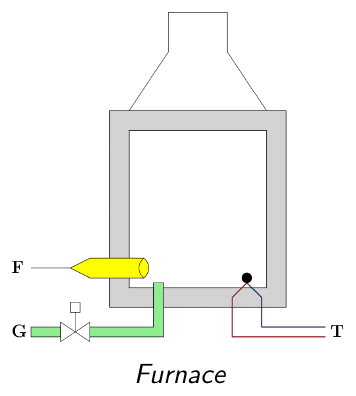
Figure 1.3: Furnace control problem.
A more realistic automatic ignition would need a timer circuit, so that if ignition has not succeeded after x seconds the gas is turned off. (This problem is solved fully in Chapter 6.)
To design the control logic, a full analysis must be carried out so that whatever state the system is in, the control signals are set appropriately. For problems with no time dependence, the analysis starts with truth tables (Chapter 2).
Key points
- Attribute-based (binary) decisions are the basis of logic control; variables are turned into attributes with thresholds.
- Even simple-looking processes need a systematic analysis of every input combination.
- Time-dependent behaviour (timers, delays) needs tools beyond truth tables: logic diagrams, response diagrams and ladder logic.
Interactive applets
Each applet runs in the page; use Open full screen for more room, or open all of this chapter’s applets together.
Applet 1.1 · Attribute vs variable sorter
Drag sensor readings (e.g. “photo-eye blocked”, “pressure 1004 mbar”, “colour = red”) into attribute or variable bins.
Teaches: The two decision categories. · Open full screen ↗
Applet 1.2 · Threshold converter
Move a slider for a continuous signal (temperature) and set a threshold, optionally with hysteresis. A live plot shows the analogue signal and the resulting binary output.
Teaches: How a decision by variables becomes an attribute, and why noisy signals near the threshold cause chattering. · Open full screen ↗
Applet 1.3 · Furnace “what-if” sandbox
Toggle power, flame present and ignition, and watch an animated furnace respond under a naive rule set.
Teaches: Why the furnace needs a systematic design; it sets up the timer-based solution in Chapter 6. · Open full screen ↗