Part Orientation
Chapter 16 · Part IV: Automated Assembly and Parts Feeding · Sources: Lectures 15 and 16
Orientation can be done in bowl or out of bowl, and can be passive (the tooling rejects wrongly oriented parts back into the bowl) or active (the tooling physically reorients parts).
16.1 In-bowl (passive) tooling
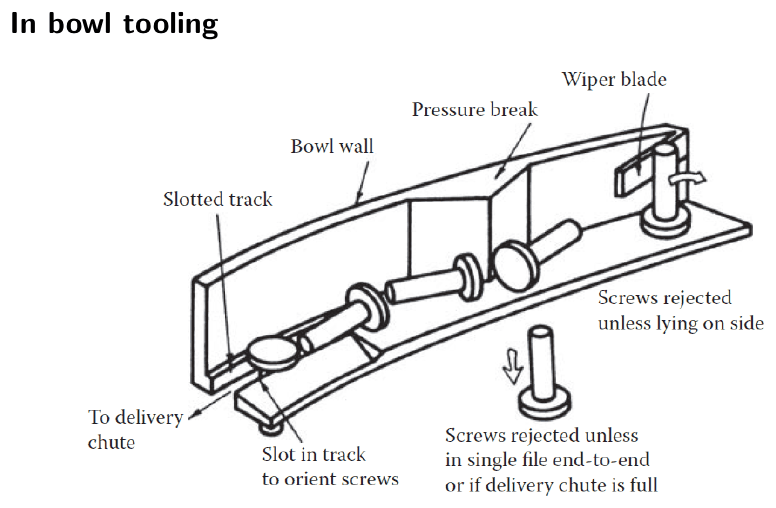
Figure 16.1: A sequence of in-bowl tooling: slotted track, pressure break and wiper blade orienting screws.
Wiper blade
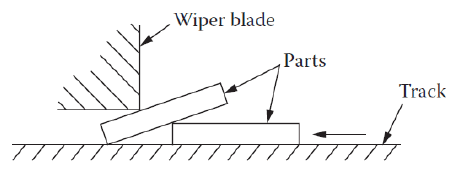
Figure 16.2: Wiper blade.
A wiper blade is a convenient way to reject parts resting on top of others. Take care, as thin parts tend to jam; this is reduced by setting the blade at an acute angle to the bowl wall.
Catalogue of passive devices
| Device | Purpose | Illustration |
|---|---|---|
| Pressure break | A ledge retains washers lying flat; washers not lying flat fall back into the bowl | 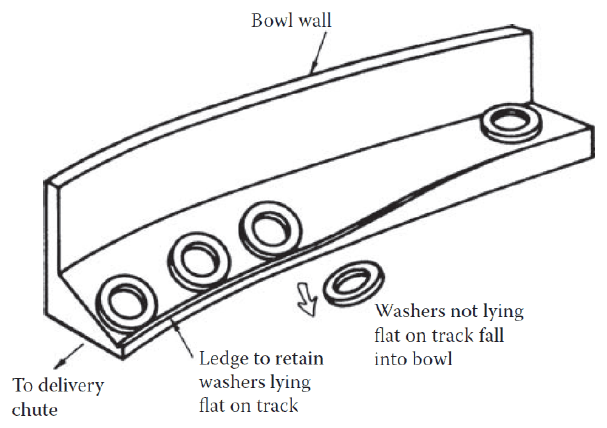 |
| Washer orientation by edge | Washer accepted (a) or rejected (b) depending on how it meets the edge | 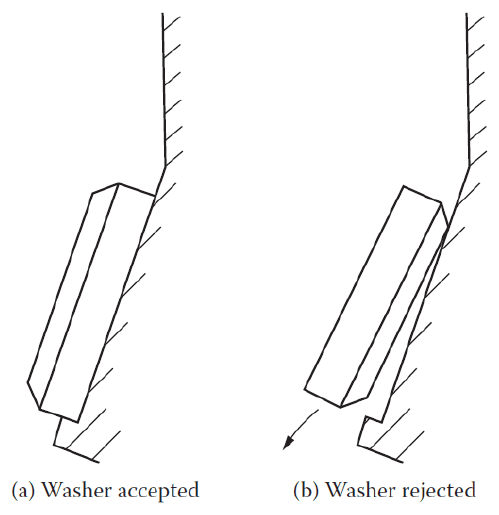 |
| Scallop cutout | Rejects cup-shaped parts standing on their tops | 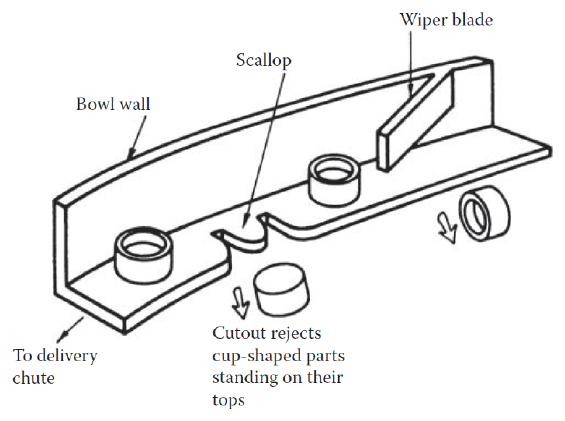 |
| V-cutout | Rejects parts resting on their tops | 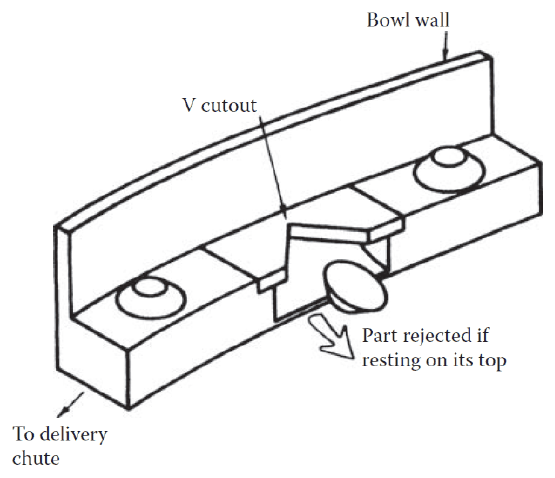 |
| Narrowed track and rail | Rejects U-shaped parts unless they climb onto the rail | 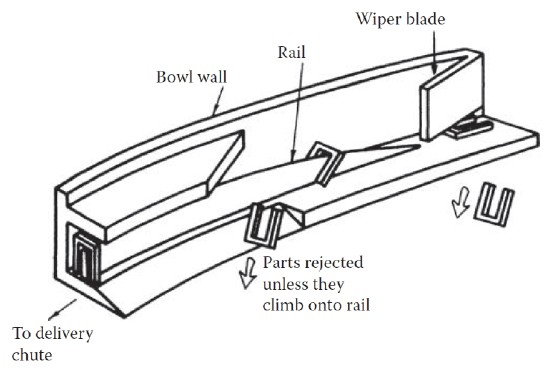 |
| Narrowed track | Rejects widthwise parts so that only one row of lengthwise parts passes | 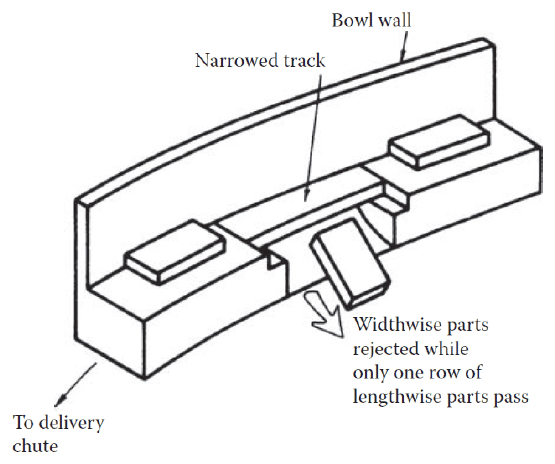 |
| Wall projection and narrowed track | Track width set to reject all parts travelling on their smaller end | 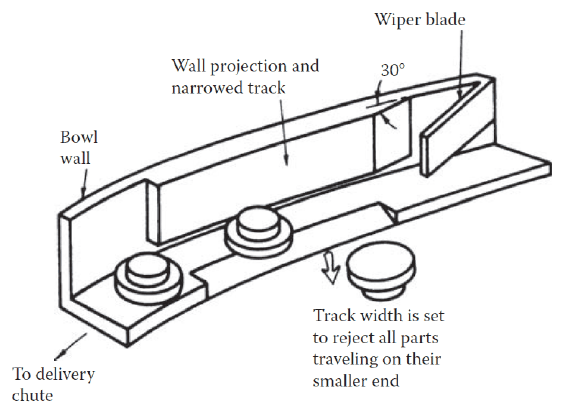 |
| Combined tooling | A wiper accepts blocks lying flat or on their side; a rail reorients blocks lying flat | 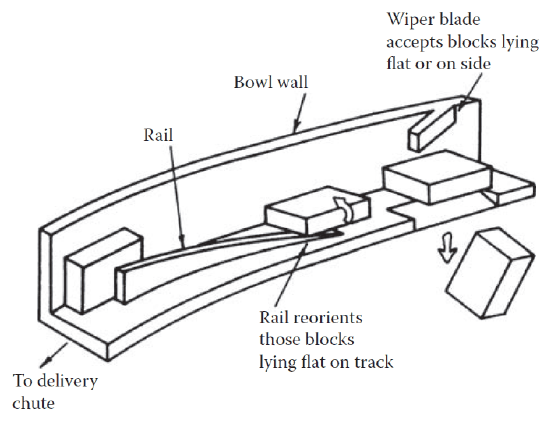 |
The best orientation tooling is usually found experimentally. Information is available for standard parts, and depends on both the part geometry and its motion on the track (e.g. how the part moves relative to the track in a vibratory bowl).
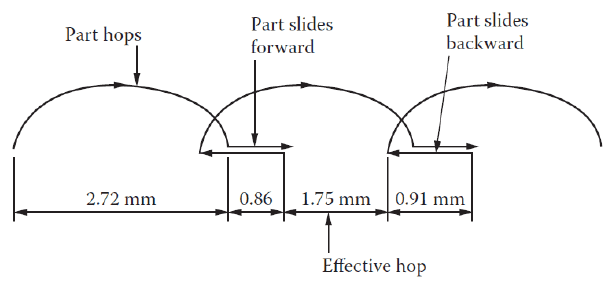
Figure 16.3: Measured motion: hop, forward slide and backward slide in each cycle.
Efficiency of orientation
The efficiency of an orientation system is the number of correctly oriented parts fed out divided by the total number entering it. It depends on:
- The orientation of parts before they enter the feed track
- The design of the orientation system
Factor 2 is set initially by part geometry and refined by trial and error. Factor 1 can be analysed from the parts’ natural resting aspects.
16.2 Orientation analysis
Consider a square prism lying on one edge and tilted through an angle about that edge.
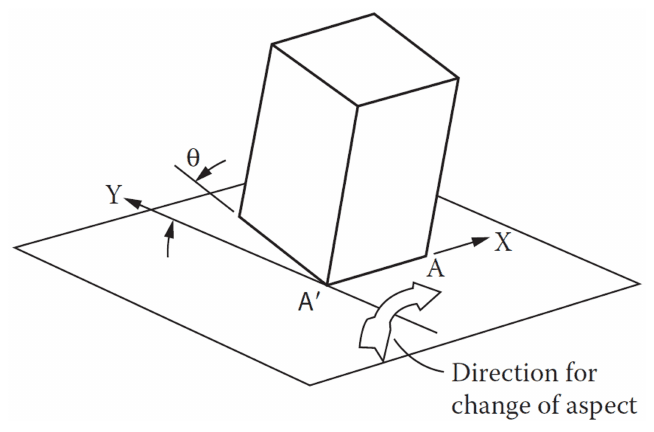
Figure 16.4: Tilting a prism from one aspect to another.
Whether the block stays in one aspect depends on the kinetic energy it has after being dropped onto the surface and the potential energy needed to tip it out of its current aspect. The probability of it turning from side to end depends on the relative energy barrier: the larger the barrier, the less likely the move.
Let \(E_{SE}\) = energy barrier from side to end, and \(E_{ES}\) = energy barrier from end to side. The block has four sides and two ends, so the probabilities of it lying on a side or an end are:
\[P_S = \frac{4E_{SE}}{4E_{SE} + 2E_{ES}} \qquad P_E = 1 - P_S\]
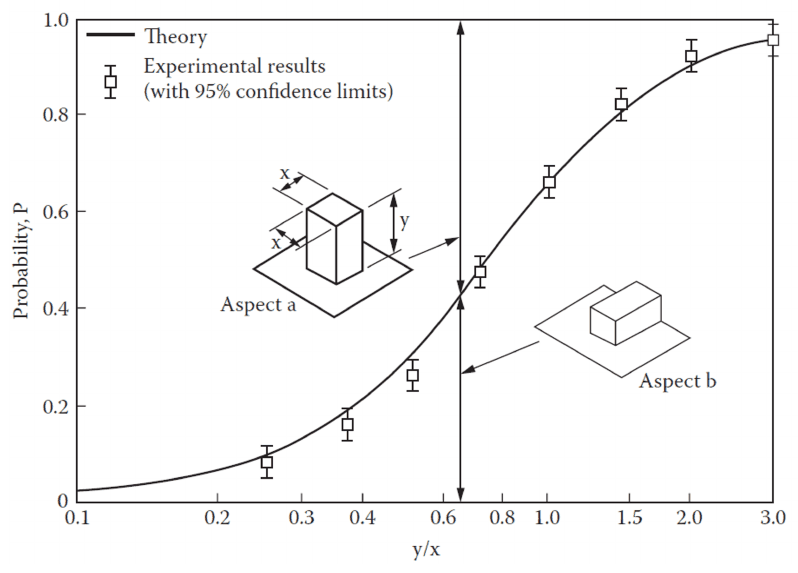
Figure 16.5: Theory (line) vs experimental results (points with 95% confidence limits) for the probability of resting in aspect a, plotted against the aspect ratio y/x.
These probabilities give the aspect, not the orientation. The probability of a part travelling side-first rather than end-first is therefore roughly 50% of the probability of it lying on its side.
Energy barrier (supplementary derivation)
For a uniform block resting on a face, the barrier to tipping over an edge is the rise of the centre of gravity:
\[E = mg\left(\sqrt{\left(\tfrac{a}{2}\right)^2 + \left(\tfrac{b}{2}\right)^2} - \tfrac{b}{2}\right)\]
where \(b\) is the dimension perpendicular to the face it rests on and \(a\) is the dimension in the direction of tipping. Substituting the side and end dimensions gives \(E_{SE}\) and \(E_{ES}\).
This derivation is not on the slides; it is added here to make the formula usable.
16.3 Out-of-bowl (active) tooling
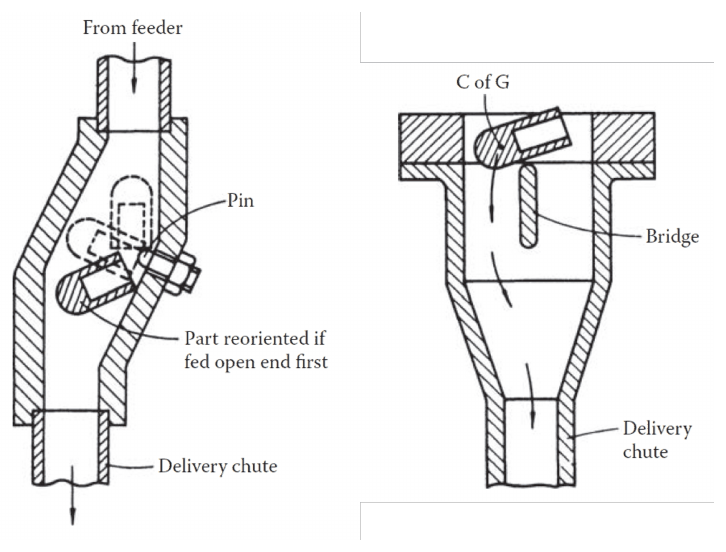
Figure 16.6: Active out-of-bowl tooling. A pin reorients a part fed open-end first; a bridge uses the centre of gravity to turn parts.
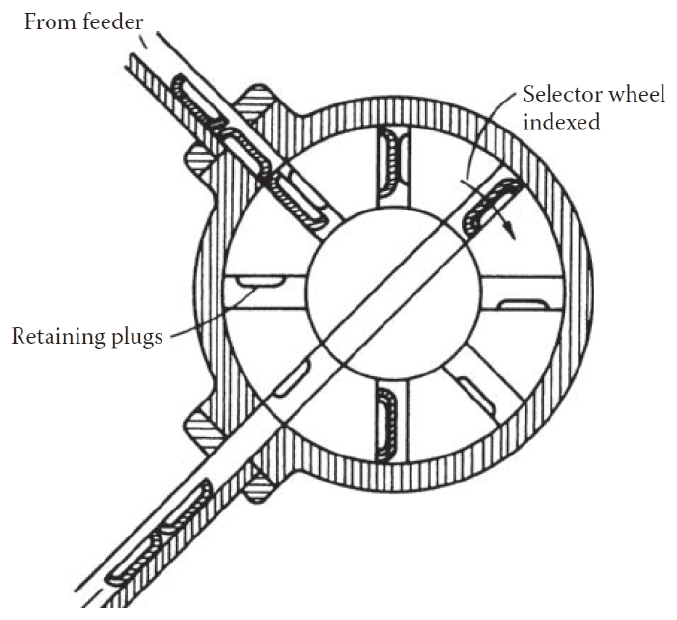
Figure 16.7: An indexed selector wheel reorients parts from the feeder before delivery.
Key points
- Passive tooling rejects wrong orientations back into the bowl; active tooling reorients them.
- Orientation efficiency = correctly oriented out ÷ total in; it depends on the natural resting aspects and the tooling design.
- Resting probability follows from energy barriers: \(P_S = 4E_{SE}/(4E_{SE}+2E_{ES})\).
Interactive applets
Each applet runs in the page; use Open full screen for more room, or open all of this chapter’s applets together.
Applet 16.1 · Drop-test Monte Carlo
Set a block’s dimensions (x, y, z) and drop 1,000 virtual blocks onto a surface (rigid-body sim or energy-barrier model); a histogram of resting aspects is compared with the \(P_S\) formula and the experimental curve.
Teaches: The energy-barrier model and its accuracy. · Open full screen ↗
Applet 16.2 · Orientation tooling designer
Build a bowl track from tooling elements (wiper, V-cutout, scallop, narrowed track, rail) and feed a stream of randomly oriented parts; the applet reports orientation efficiency and the jam rate.
Teaches: How tooling choices affect efficiency; trial and error, as in industry. · Open full screen ↗
Applet 16.3 · Aspect vs orientation tree
An interactive probability tree: aspect (side or end) → orientation (side-first or end-first, open-end up or down) → accept or reject at each tooling element.
Teaches: Combining probabilities to get overall efficiency. · Open full screen ↗
Applet 16.4 · Wiper-blade angle explorer
Rotate the wiper blade angle and watch thin parts jam or pass.
Teaches: Why an acute angle reduces jamming. · Open full screen ↗