Lecture 12: Star–Delta Circuits
Contents
This lecture is a worked three-phase exercise, building on the star and delta relationships and the star–delta conversions of Lecture 11.
Delta–Delta Example
The three-phase, delta-connected system shown supplies power to a balanced load through transmission lines with impedance \(Z_{line} = R_{line} + jX_{line} = 0.2 + j0.2\ \Omega\). The voltage sources are \(V_{ry} = 400\angle 30^\circ\) V, \(V_{br} = 400\angle 150^\circ\) V and \(V_{yb} = 400\angle -90^\circ\) V. The load impedances are \(Z_\Delta = 27 + j9\ \Omega\).
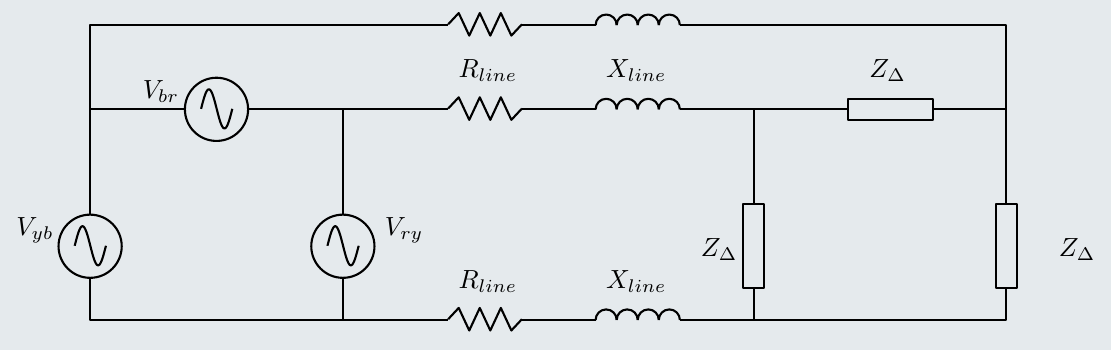
Find:
- It is often convenient to analyse delta-connected systems by finding the star-connected equivalent circuit. Calculate the star-connected equivalents for the source and the load.
- Calculate the magnitude of the phase current flowing in each phase of the load of the star-connected equivalent circuit.
- Using the phase current from part 2 and one phase of the star-connected equivalent, calculate the line-to-neutral voltage and the line-to-line voltage at the load.
- Using the line-to-line voltage from part 3, calculate the magnitude of the phase current flowing in each phase of the load of the delta-connected circuit.
- Using the phase current from part 4, calculate the total true power dissipated in the load of the delta-connected circuit.
Worked Solution
Worked for these notes; the slides give the exercise only.
1. Star equivalents
Source. In star, the line voltage is \(\sqrt{3}\) times the phase voltage and leads it by 30°. The line voltage \(V_{ry} = 400\angle 30^\circ\) therefore corresponds to a phase (line-to-neutral) voltage
\[ V_{rn} = \frac{400}{\sqrt{3}}\angle(30^\circ - 30^\circ) = 230.9\angle 0^\circ\ \text{V} \]
with \(V_{yn} = 230.9\angle -120^\circ\) V and \(V_{bn} = 230.9\angle 120^\circ\) V.
Load. For a balanced load,
\[ Z_Y = \frac{Z_\Delta}{3} = \frac{27 + j9}{3} = 9 + j3\ \Omega \]
2. Phase current in the star equivalent
Each phase sees the line and load impedances in series:
\[ Z = Z_{line} + Z_Y = (0.2 + 9) + j(0.2 + 3) = 9.2 + j3.2\ \Omega = 9.74\angle 19.18^\circ\ \Omega \]
\[ I = \frac{230.9\angle 0^\circ}{9.74\angle 19.18^\circ} = 23.7\angle -19.18^\circ\ \text{A} \]
This is also the line current of the original delta system.
3. Load voltages
\[ V_{p,load} = I\,|Z_Y| = 23.7 \times \sqrt{9^2 + 3^2} = 23.7 \times 9.49 = 224.9\ \text{V (line to neutral)} \]
\[ V_{l,load} = \sqrt{3} \times 224.9 = 389.6\ \text{V (line to line)} \]
About 10 V of the 400 V line voltage is dropped across the transmission lines.
4. Phase current in the delta load
Each delta impedance has the line-to-line voltage across it:
\[ I_{p,\Delta} = \frac{V_{l,load}}{|Z_\Delta|} = \frac{389.6}{\sqrt{27^2 + 9^2}} = \frac{389.6}{28.46} = 13.7\ \text{A} \]
As a check, \(I_l/\sqrt{3} = 23.7/\sqrt{3} = 13.7\) A, as expected for delta.
5. Total true power in the load
\[ P = 3\,I_{p,\Delta}^2 R_\Delta = 3 \times 13.7^2 \times 27 = 15.2\ \text{kW} \]
The star equivalent gives the same answer: \(3 \times 23.7^2 \times 9 = 15.2\) kW.
Interactive Elements
Each element below runs in the page; use Open full screen for more room.
Delta-to-star solver
The same circuit with sliders for the line and load impedances and the supply voltage, stepping through the five parts: converting to star, solving one phase, and converting back, with each intermediate value shown. Students can check their own working for any values.
Line loss explorer
Vary the line impedance and see the load voltage, the line losses and the efficiency of transmission change, showing why long lines need higher voltages.
Knowledge Check
Q1. Why is a delta-connected system often analysed by converting it to a star equivalent?
Answer
In star, each phase can be treated as a simple single-phase circuit from a line-to-neutral source through the line and load impedances in series. One phase is solved and the others follow by ±120°.
Q2. A balanced delta load has \(Z_\Delta = 27 + j9\ \Omega\). What is its star equivalent?
Answer
\(Z_Y = Z_\Delta/3 = 9 + j3\ \Omega\).
Q3. A delta source has a line voltage of 400 V. What is the phase voltage of its star equivalent?
Answer
\(400/\sqrt{3} = 230.9\) V.
Q4. In the example, the line current was 23.7 A. Why is the current in each delta load impedance 13.7 A rather than 23.7 A?
Answer
In delta, each line current is the phasor difference of two phase currents 120° apart, so \(I_l = \sqrt{3}\,I_p\), giving \(I_p = 23.7/\sqrt{3} = 13.7\) A.
Q5. In the example, what is the total real power lost in the transmission lines?
Answer
\(P = 3I_l^2R_{line} = 3 \times 23.7^2 \times 0.2 = 337\) W.
Q6. If the line impedance were zero, what would the line-to-line voltage at the load be, and what power would the load take?
Answer
The full 400 V would appear across each delta impedance, so \(I_p = 400/28.46 = 14.05\) A and \(P = 3 \times 14.05^2 \times 27 = 16.0\) kW.