Lecture 13: Induction Motors
AC Motors
With the almost universal adoption of AC distribution systems, the field of application of AC motors has broadened considerably. This has given rise to a number of motor types for both single- and three-phase applications:
| Supply | Type | Power range (hp) | Rotor | Stator | Comments and applications |
|---|---|---|---|---|---|
| Three phase | Induction | 1–5000 | Squirrel cage | Three-phase armature windings | Simple, rugged construction; very common: fans, pumps |
| Wound field | Adjustable field using rotor resistance: cranes, hoists | ||||
| Synchronous | 1–5 | Permanent magnet | Precise speed: transport of sheet material | ||
| 1000–50 000 | DC field winding | Large constant loads; potential for power factor correction | |||
| Single phase | Induction | ⅓–5 | Squirrel cage | Main and auxiliary windings | Several types: split phase, capacitor start, capacitor run. Simple and rugged; many household applications such as fans, water pumps (washing machines, dishwashers) and refrigerators |
| Synchronous | \(\tfrac{1}{10}\) or less | Reluctance | Armature windings | Low torque, fixed speed: timing applications |
Power Flow and Losses
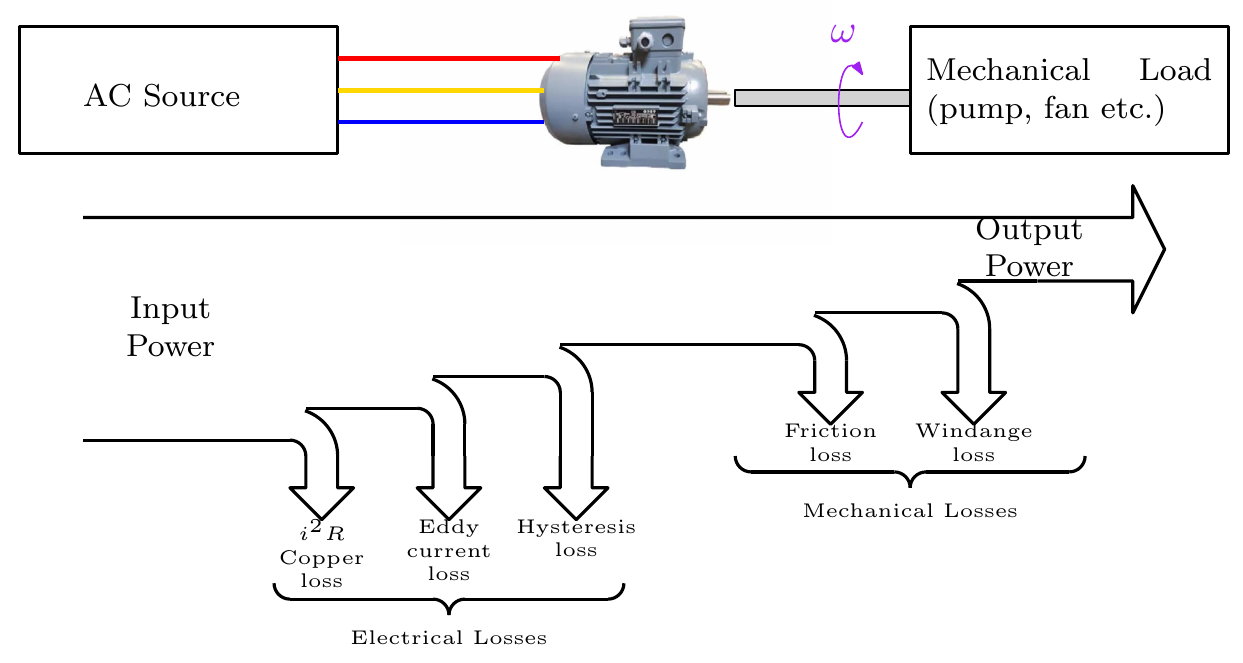
The input power from the AC source is reduced by:
- Electrical losses: \(i^2R\) copper loss in the windings, eddy current loss and hysteresis loss in the core.
- Mechanical losses: friction and windage.
What remains is the mechanical output power delivered to the load (a pump, fan etc.).
The Three-Phase Induction Motor
Of all AC motors, the three-phase induction motor is the most widely used in industry, because it:
- is very simple and extremely rugged;
- is relatively low cost and extremely reliable;
- has reasonably high efficiency;
- has a reasonably good power factor;
- needs minimal maintenance;
- starts from rest on its own, unlike some other motors in this course.
Drawbacks of the three-phase induction motor:
- Its speed cannot be varied without sacrificing efficiency (on a fixed-frequency supply).
- Its speed decreases as the load increases.
- It can have a low starting torque.
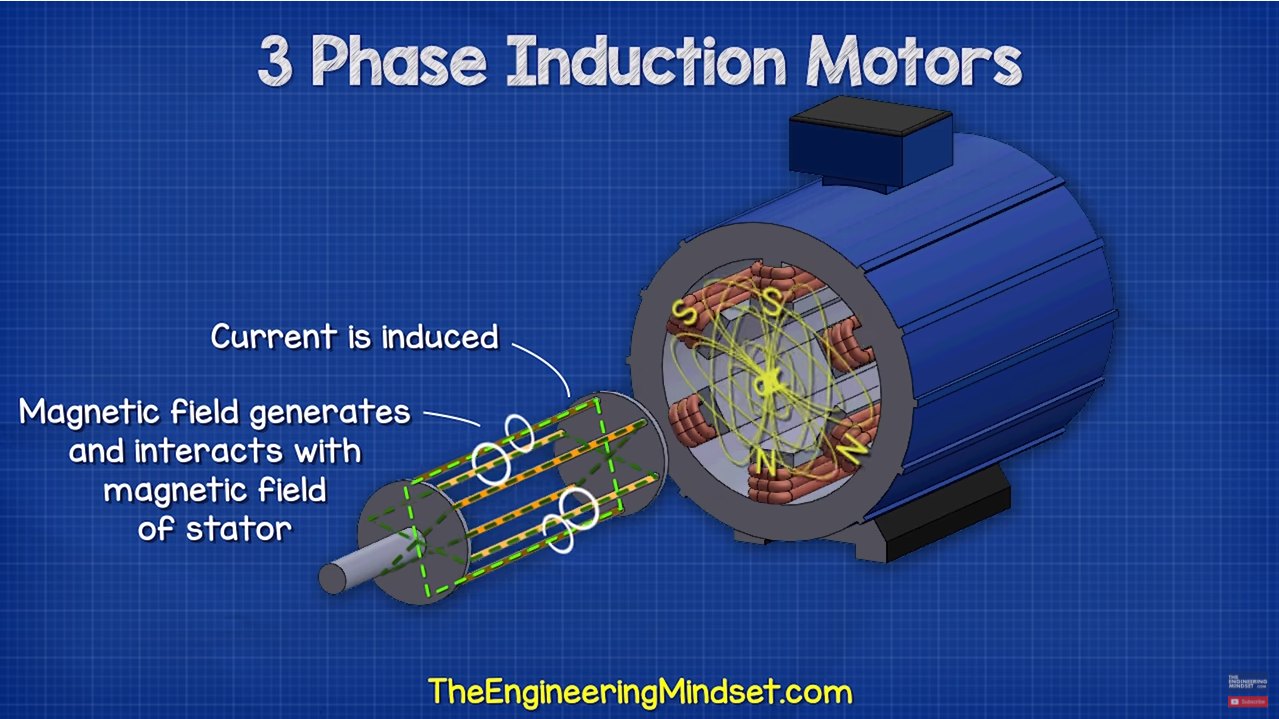
Engineering Mindset video: “3 Phase Induction Motors”.
Key components
- Frame: typically alloy cast iron.
- Stator and rotor core: built from high-quality, low-loss silicon steel laminations, enamelled on both sides.
- Stator and rotor windings: carefully spaced for effective air circulation, and braced to withstand centrifugal forces.
- Air gap: the stator bore is carefully machined to give a uniform air gap. Flux losses occur in the air gap, so its uniformity is important.
- Shafts and bearings: ball and roller bearings, chosen to suit the application and give trouble-free running.
- Fans: light aluminium fans keyed onto the rotor shaft circulate air over the motor body for cooling.
- Slip rings (wound rotor only): made from high-quality phosphor bronze.
Rotor Types
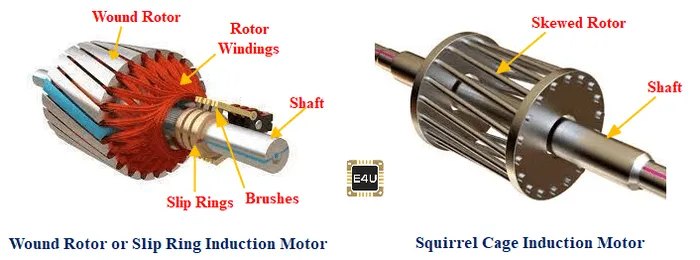
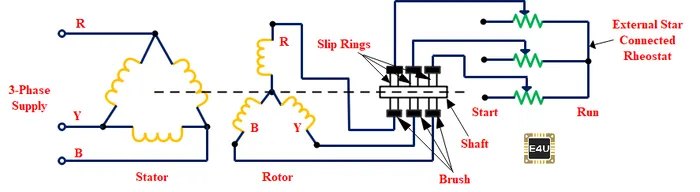
| Wound rotor (slip ring) | Squirrel cage | |
|---|---|---|
| Construction | Complicated, due to slip rings and brushes | Simple: fixed, skewed rotor bars |
| Starting method | Needs slip rings, brush gear, a short-circuiting device, starting resistance etc. | Can be started with a star–delta starter |
| Starting torque | High, thanks to the external resistance in the rotor circuit | Poor, and cannot be improved |
| Rotor | Wound, with its terminal ends connected to three slip rings on the shaft | Skewed bars short-circuited by end rings |
| Induced rotor voltage | Higher | Lower |
| Speed control | Possible by the rotor resistance method | Not possible by rotor resistance |
| Maintenance | Frequent, because of the brushes and slip rings | Less |
| Efficiency | Lower, due to power loss in the external resistance | High |
| Cost | Higher | Lower |
| Applications | Where high starting torque is required: cranes, hoists, elevators | Lathes, drilling machines, blowers, fans |
| Use | Rare: about 5–10% of industrial induction motors | Widespread: about 90% of industrial induction motors |
Advantages of the wound rotor motor
- High starting torque, due to the external resistance in the rotor circuit.
- High overload capacity, with smooth acceleration under heavy loads.
- Lower starting current than a squirrel cage motor: the added rotor resistance increases the rotor impedance.
- Adjustable speed, by varying the rotor circuit resistance; it is considered a “variable speed motor”.
- Improved power factor.
Advantages of the squirrel cage motor
- Simple and rugged construction.
- Cheaper.
- Low maintenance cost.
- Nearly constant speed.
- High overload capacity.
- Simple starting arrangement.
- More pull-out torque and greater maximum power output.
- Better cooling, thanks to the bare end rings.
Rotation and Slip
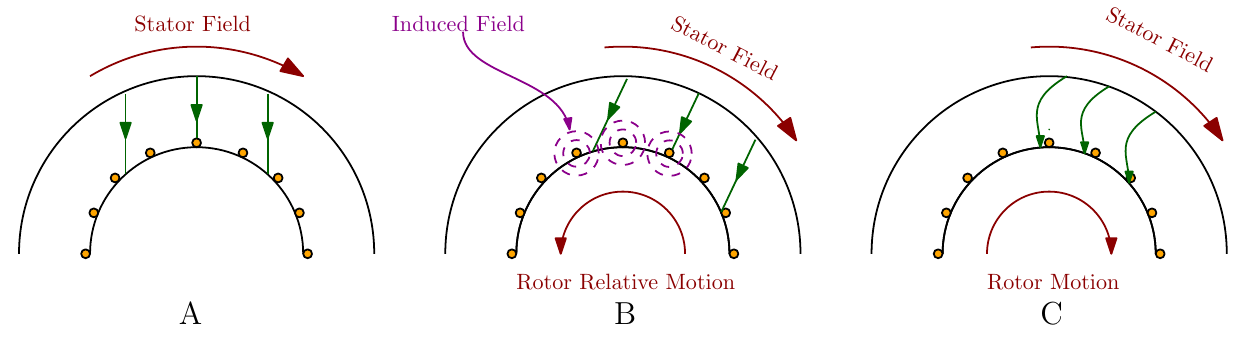
- A: Assume the rotor is not moving and the stator field is energised and rotating clockwise.
- B: The movement of the stator field induces currents, and a magnetic field, in the rotor (think of the bars of the squirrel cage). Relative to the stator field, the rotor moves anticlockwise.
- C: The induced current and the resulting force oppose this relative motion (Lenz’s law), so the rotor begins to rotate clockwise, following the field.
This is the fundamental principle of operation of an induction motor.
In practice the rotor never “catches up” with the stator field. If it did, there would be no relative motion between the field and the rotor, so no induced current in the rotor and no force or torque. An induction motor always runs at a speed below that of the stator field.
The speed of the stator field is called the synchronous speed \(N_s\). The difference between it and the actual rotor speed \(N_r\) is called the slip: the amount by which the rotor slips back from synchronous speed.
\[ s = \frac{N_s - N_r}{N_s}, \qquad \%s = \frac{N_s - N_r}{N_s} \times 100 \]
\(N_s - N_r\) is sometimes called the slip speed. The rotor speed is
\[ N_r = N_s\,(1 - s) \]
The slip at full load varies from about 6% for small motors to about 2% for large machines, so the induction motor can be regarded as practically a constant-speed machine for a given supply frequency. The difficulty of varying its speed economically has largely been overcome by modern variable-speed power electronic drives, which vary the frequency of the applied voltage, and hence the speed.
Frequency of the Rotor e.m.f.
For a three-phase winding with \(p\) pairs of poles supplied at frequency \(f\) (Hz), the rotating flux turns at \(N_s\) revolutions per second, where
\[ f = N_s\,p \qquad \Big(\text{or } N_s = \frac{60f}{p} \text{ in rpm}\Big) \]
The rotor conductors are cut by the rotating flux at \((N_s - N_r)\) revolutions per second, so the frequency of the rotor e.m.f. is
\[ f_r = (N_s - N_r)\,p \]
Since \(s = \dfrac{N_s - N_r}{N_s}\), we have \(N_s - N_r = sN_s\), and
\[ f_r = s\,N_s\,p = s\,f \]
Worked Examples
Example 1
A three-phase induction motor is wound for four poles and supplied from a 50 Hz system. Calculate (a) the synchronous speed, (b) the speed of the rotor when the slip is 4%, and (c) the rotor frequency when the rotor speed is 600 rpm.
(a) Four poles means two pole pairs:
\[ N_s = \frac{60f}{p} = \frac{60 \times 50}{2} = 1500\ \text{rpm} \]
(b)
\[ s = \frac{N_s - N_r}{N_s} \;\Rightarrow\; 0.04 = \frac{1500 - N_r}{1500} \;\Rightarrow\; N_r = 1440\ \text{rpm} \]
(c)
\[ s = \frac{1500 - 600}{1500} = 0.6, \qquad f_r = sf = 0.6 \times 50 = 30\ \text{Hz} \]
Example 2
An 8-pole induction motor is supplied at 50 Hz, and its shaft speed is measured as 735 rpm. What are (a) the synchronous speed and (b) the per-unit slip?
(a) Eight poles means four pole pairs: \(N_s = \dfrac{60 \times 50}{4} = 750\) rpm.
(b) \(s = \dfrac{750 - 735}{750} = 0.02\).
Interactive Elements
Each element below runs in the page; use Open full screen for more room.
Rotating field and induction motor
Three stator coils fed 120° apart produce a rotating field; a squirrel cage rotor follows it. A load slider increases the slip, showing the rotor falling further behind, the rotor-current frequency \(f_r = sf\) rising, and that at zero slip there is no induced current and no torque.
Synchronous speed and slip calculator
Set the supply frequency, the number of poles and the rotor speed (or slip) to get \(N_s\), \(N_r\), \(s\) and \(f_r\), with the lecture’s examples as presets, and a table of synchronous speeds for 2 to 12 poles at 50 and 60 Hz.
Power flow (Sankey) diagram
Enter the input power and each loss to see the power-flow diagram drawn to scale and the efficiency worked out.
Wound rotor versus squirrel cage
Toggle the rotor type and add external rotor resistance to see the effect on starting torque and starting current.
Knowledge Check
Q1. Why is the three-phase induction motor the most widely used motor in industry? Give three reasons.
Answer
Any three of: simple and extremely rugged; low cost and very reliable; reasonably high efficiency; reasonably good power factor; minimal maintenance; self-starting from rest.
Q2. Explain why an induction motor’s rotor can never run at synchronous speed.
Answer
Torque comes from currents induced in the rotor by the stator field moving relative to it. At synchronous speed there would be no relative motion, so no induced e.m.f., no rotor current and no torque; even friction alone would slow the rotor back below synchronous speed.
Q3. A 6-pole motor runs from a 50 Hz supply. What is its synchronous speed?
Answer
Six poles is three pole pairs: \(N_s = 60 \times 50/3 = 1000\) rpm.
Q4. The same 6-pole motor runs at 960 rpm. What is the slip, and what is the frequency of the rotor currents?
Answer
\(s = (1000 - 960)/1000 = 0.04\) (4%), and \(f_r = sf = 0.04 \times 50 = 2\) Hz.
Q5. What is the rotor frequency of an induction motor at standstill (for example at the instant of starting)?
Answer
At standstill \(N_r = 0\), so \(s = 1\) and \(f_r = f\): the rotor frequency equals the supply frequency.
Q6. Which rotor type would you choose for a crane hoist, and why?
Answer
A wound rotor (slip ring) motor: external resistance in the rotor circuit gives high starting torque and lower starting current, and allows the speed to be adjusted.
Q7. Give two disadvantages of the wound rotor motor compared with the squirrel cage motor.
Answer
Any two of: more complicated construction; frequent maintenance of brushes and slip rings; lower efficiency (power lost in the external resistance); higher cost.
Q8. Name the electrical and mechanical losses in an AC motor.
Answer
Electrical: \(i^2R\) (copper) loss, eddy current loss, hysteresis loss. Mechanical: friction and windage.
Q9. Why is the induction motor described as practically a constant-speed machine, and how is variable speed achieved in modern drives?
Answer
Full-load slip is only about 2–6%, so the speed stays close to synchronous speed, which is fixed by the supply frequency and the number of poles. Modern power electronic drives vary the frequency of the applied voltage, which changes the synchronous speed and hence the motor speed.
Q10. What is the purpose of the air gap being uniform, and of skewing the bars of a squirrel cage rotor?
Answer
Flux losses occur across the air gap, so a uniform gap keeps the flux, and the forces on the rotor, even all the way round. Skewing the bars smooths the torque and reduces noise and cogging (the rotor locking to the stator slots).