SCADA and the ISA-95 Model
Chapter 9 · Part III: Industrial Communications · Source: Lecture 9
9.1 The ISA-95 automation pyramid
ANSI/ISA-95 (usually just ISA-95) is an international standard from the International Society of Automation for developing an automated interface between enterprise and control systems.
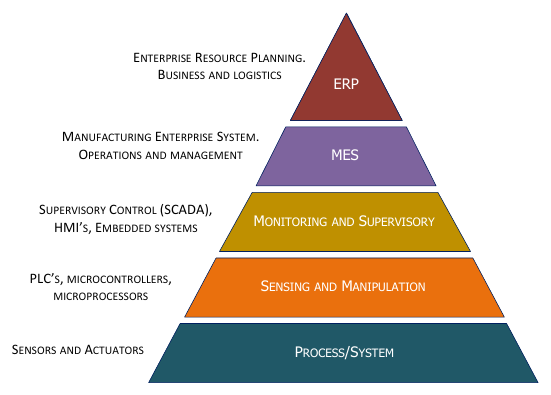
Figure 9.1: The ISA-95 pyramid.
| Level | Name | Function | Examples |
|---|---|---|---|
| 4 | ERP: Enterprise Resource Planning | Business and logistics | Order management, finance, planning |
| 3 | MES: Manufacturing Execution System | Operations and management | Scheduling, tracking, quality records |
| 2 | Monitoring and supervisory | Supervisory control | SCADA, HMIs, embedded systems |
| 1 | Sensing and manipulation | Control | PLCs, microcontrollers, microprocessors |
| 0 | Process / system | Field | Sensors and actuators |
The slide labels MES as “Manufacturing Enterprise System”; the standard term is Manufacturing Execution System.
9.2 The information loop
The bottom two layers of ISA-95 form an information loop: the sensor feeds data to the PLC; depending on its program, the PLC changes the actuator; this changes the technical process, which changes the sensor value, and the loop continues.
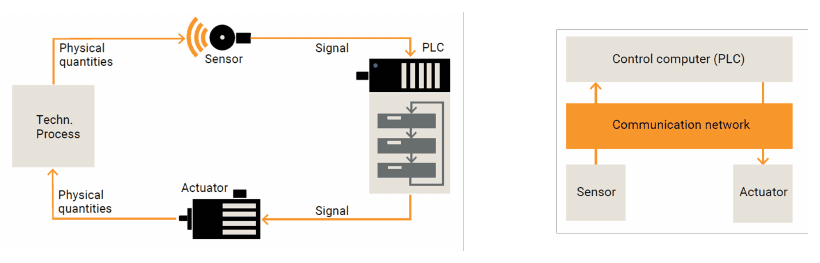
Figure 9.2: Sensor → PLC → actuator → process → sensor.
9.3 SCADA
Supervisory Control And Data Acquisition (SCADA) sits above many such information loops. Managing an automated enterprise requires a way to collect and send information between several information loops or processes.
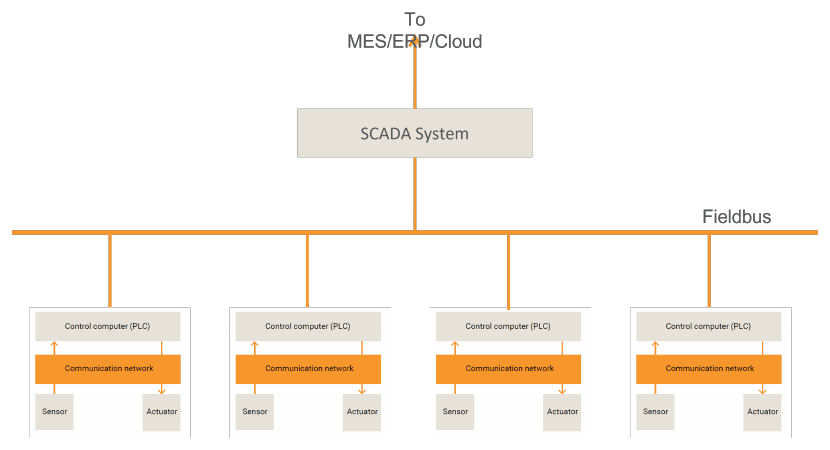
Figure 9.3: A SCADA system supervising several PLC-controlled loops over a fieldbus, and passing data up to MES, ERP or the cloud.
Collecting and sending information across a local area network (LAN) requires three essential components:
- Topology: how the network is constructed
- Transmission medium: the physical means of data communication
- Network access protocol: how the communications are decoded
These are the subjects of Chapter 10 and Chapter 11.
Key points
- ISA-95 layers run from field devices (0) to ERP (4); SCADA and HMIs sit at level 2.
- Each sensor → PLC → actuator → process loop is an information loop; SCADA supervises many of them.
- Networking these loops needs a topology, a medium and a protocol.
Interactive applets
Each applet runs in the page; use Open full screen for more room, or open all of this chapter’s applets together.
Applet 9.1 · Clickable ISA-95 pyramid
Click each level to reveal its function, typical devices or software, data rates and time scales (ms at the field, days at ERP); drag example items (“HMI screen”, “proximity sensor”, “work order”) onto the right level.
Teaches: The layers and where things belong. · Open full screen ↗
Applet 9.2 · Information loop animation
A tank-level process: the sensor reading flows to the PLC, the PLC opens a valve, the level changes, and the loop repeats. The learner changes the setpoint or scan time and watches the response.
Teaches: The closed information loop at levels 0–1. · Open full screen ↗
Applet 9.3 · Mini SCADA dashboard
A simulated HMI showing several stations’ live values, alarms and trends, with buttons to acknowledge alarms or change setpoints that propagate to simulated PLCs.
Teaches: What “supervisory control and data acquisition” means in practice. · Open full screen ↗